
13 min read
Plant-based or plant-malignant oils? (Part 2)
Vegetable oils are unhealthy. Several dietitians, nutrition experts, scientists and investigative journalists are convinced of this. They mainly mean refined vegetable oils that are high in omega-6 fatty acids. These oils contain dangerous chemicals, disturb our fatty acid balance and are prone to oxidation. This is often claimed without any backing, but sometimes scientific research is cited too. Anyone who dives into the scientific literature behind the dangers of vegetable oils gets tangled in a web of reviews with nice stories about mechanisms and clinical studies. How strong is the scientific support for the dangers of vegetable oils? Are vegetable oils actually plant-malignant oils?

Vegetable oils (rich in omega-6 fatty acids) are said to be THE cause of the biggest diseases of affluence of the moment. Despite potentially plausible mechanisms, ‘Plant-based or plant-malignant oils? Part 1’ showed that the scientific evidence for the relationship between omega-6 fatty acids and coronary heart disease (cardiovascular disease) was in any case not that strong. Let alone that the cited narrative review contains bad science and interpretations of the scientific literature. According to Joseph there is also a strong correlation between the rise in vegetable oil consumption and the biggest pandemic of all: obesity. Here too, vegetable oils rich in omega-6 fatty acids are said to be the cause. On top of that, the rise in vegetable oil consumption is said to have a major impact on how old we get. Let's start with our weight: how strong is the evidence that Joseph cites for the relationship between omega-6 intake and overweight?
Developmental Origin of Health and Disease hypothesis (DOHD)
The impact of nutrition on our health already begins with a foetus in the mother's womb. It may even begin before the foetus has been conceived at all. We call this crucial period the ‘first 1,000 days’: the period from conception to the child's second birthday. During this period the blueprint and the foundation of the body are formed, which lay the basis for an (un)healthy future. This is also called ‘programming’. Research on children who were born during or just after the Dutch famine of 1944-1945 shows that these children had a higher risk of various health problems later in life, such as overweight, cardiovascular disease and diabetes. It also mattered which stage of pregnancy the mother was in, which determined the risks the child runs later in life. This research is the basis of the developmental origin of health and disease hypothesis (DOHDH), which states that the environment (and nutrition) in the first 1,000 days has a large influence on physiological function and the risk of disease in adulthood.
Omega-6 and overweight
The question is: what role does the consumption of omega-6 fatty acids play in this story? Well, according to Muhlhausler, eating a Western diet in the first 1,000 days leads to higher risks of all diseases of affluence -- and what is a Western diet rich in? Omega-6 fatty acids, Muhlhausler reasons. The narrative review by Muhlhausler focuses on research into exposure to large amounts of omega-6 fatty acids before birth or in early childhood and the effect on the weight of children (and at later ages). They look at evidence from research with both animals and humans. The question being: does a high omega-6 fatty acid intake programme us for a life with overweight?
Muhlhausler concludes that in vitro research and research with animals shows that omega-6 consumption by the mother (before or after conception) can have an effect on the child's body. The body would be ‘programmed’ to build up fat tissue faster and break it down more slowly. However, there are no studies with humans that have investigated this hypothesis. This context is not given by Joseph in his video. Muhlhausler notes, just like Joseph, that in the Western world the intake of omega-6 and the prevalence of obesity have risen sharply together. Here Muhlhausler adds the remark: ‘Despite a decrease in saturated fat intake’. I have covered the argument that saturated fat (from the 1950s onwards) has been portrayed as the bogeyman for all diseases of affluence (and thus also overweight) before in ‘Fakenieuwsvoordiëtisten: geen verband verzadigd vet en welvaartsziekten’.
"The increase in dietary intakes of omega-6 PUFA has been documented in several large studies, and has occurred over a time when the prevalence of obesity in the population has risen sharply, despite declines in the per capita intake of saturated fat. There is evidence supporting the hypothesis that omega-6 PUFA have proadipogeneic and prolipogenic properties, and recent work in animals has demonstrated that exposure to a high omega-6 PUFA diet during early life is sufficient to programme an increased body fat mass in the offspring. … It is clear, however, that there is an urgent need for human clinical studies, in particular randomized controlled trials, to conclusively demonstrate whether there is a causal link between maternal omega-6 PUFA intakes and health outcomes in children, including obesity and insulin resistance.”
Although Muhlhausler concludes that no research has been done on the effect of omega-6 consumption (by the mother) on (over)weight in children, in her review Muhlhausler does refer to a study that is said to have looked at the effect of omega-6 intake in the first 1,000 days on fat cell formation in the child.
“In particular there is evidence that exposure to excess omega-6 PUFA before birth or in early infancy may be responsible for promoting fat cell formation early in life and thereby predisposing individuals to excess accumulation of body fat as children and adults.”
However, if we look at the source(10) for this fairly bold, and yet quite crucial, claim, it refers to a study that has not yet been carried out.
(source 10)“The Impact of Nutritional Fatty Acids during Pregnancy and Lactation on Early Human Adipose Tissue Development Rationale and Design of the INFAT Study.”
I cannot find the final study. As if it was never carried out, but even if the study had been carried out, there is a problem. The aim of the study was not at all to investigate what the effect of omega-6 intake on fat formation in children is. The aim of the study was to increase omega-3 consumption and thereby lower the ratio between omega-6 and omega-3 fatty acids. This would mean that it is not about too high an omega-6 intake in itself, but about the ratio to omega-3. If you ask me, that is more about a shortage of omega-3 than a surplus of omega-6 (otherwise the omega-6 intake would have been reduced). So the hypothesis that a high omega-6 intake by a mother has an effect on the weight of her child is still just a theory that has not yet been investigated in living humans.
How strong is the evidence for his claim that ‘There is a strong correlation between vegetable oils (rich in omega-6 fatty acids) and diseases of affluence such as cardiovascular disease, overweight and type 2 diabetes. According to some doctors and scientists, the omega-6 fatty acid linoleic acid is THE cause of those health problems’?
Joseph refers to two narrative reviews as evidence for the relationship between omega-6 fatty acid (linoleic acid) consumption and diseases of affluence such as cardiovascular disease and overweight. As I already said in part 1 (and in ‘What is the Pyramid of Evidence’ ) there is a big difference between narrative and systematic reviews. The problem with narrative reviews is the lack of transparency about the search for and assessment of literature. The strength of the evidence of a narrative review stands or falls with the integrity and skill of the authors. Because of, among other things, (deliberately or unwittingly) wrong source references (bad science) and wrongly interpreted scientific literature, the strength of the evidence of both the study (from part 1) by Dinicolantonio and the study by Muhlhausler is doubtful. In addition, both theories have never been confirmed in research with humans, which does not help the strength of the evidence either.
The conclusion
The rise in consumption of omega-6 fatty acids has gone hand in hand with a rise in diseases of affluence. There are several potentially plausible mechanisms that explain an actual causal link: the Polyunsaturated Fatty Acid Oxidation (MOVO) hypothesis and the Developmental Origin of Health and Disease (DOHD) hypothesis (doesn't sound so nice in Dutch). However, when you dive deeper into the scientific support for the theories, you find that the strength of the evidence is very low. Although the mechanisms are plausible and parts of them have often been confirmed with in vitro and animal research, we are still waiting for research with humans that can really confirm the theories. In addition, it seems that scientific literature was not always handled carefully when it was cited, translated and assessed as support for the narrative reviews. It seems that Joseph has not looked at the content of the studies that he cites to support his claim about the causal link between omega-6 fatty acids and diseases of affluence. A YouTube video is not scientific evidence. The storytelling may be strong, but so far the evidence he provides is not. Interpreting scientific literature is not as easy as translating a summary and conclusion. Proper research is needed that looks at the content of studies, so that the content of a study can be assessed for quality. This is something Joseph has not done.
Claim: There is a correlation between how big an animal is and how long it lives. It is the case that the bigger an animal is, the slower its metabolism and the longer its lifespan. But this theory has exceptions (such as humans). This can be explained by omega-6 fatty acid consumption, because the more vulnerable our cells are to oxidation, the shorter we live.
Besides a relationship with diseases of affluence, there is also said to be a relationship with lifespan. The more you eat of it, the shorter you live. Where we first thought that lifespan is mainly influenced by the size (in mass) of an animal, it now turns out that this theory is not complete—and omega-6 intake fills the gap in this theory perfectly. The reasoning goes roughly as follows: How long you live depends on how long your cells stay alive. How long our cells live depends on how resistant they are to oxidation. The more omega-6 fatty acids we eat, the more vulnerable our cells become to oxidation, the shorter we live. In other words, we are talking about the MOVO hypothesis again. At least, that is what Anthonoy Hulbert states in his research that Joseph cites.
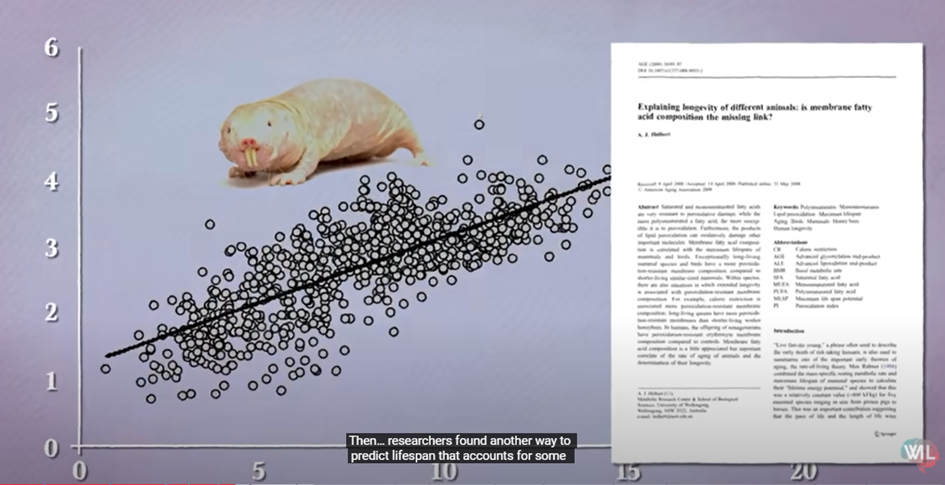
Source: Hulbert, A.J. (2008) Explaining longevity of different animals: is membrane fatty acid composition the missing link?
Jospeh bases claim 2 on the ‘membrane pacemaker theory of ageing’ by Anthony Hulbert. The theory is very interesting and that is why I would like to explain who A.J. Hulbert is and what his theory involves.
Anthony Hulbert is Emeritus Professor at Wollonong University. He specialises in zoology and has an impressive career behind him with more than 100 publications and 10,000 citations. During his career he became fascinated by the lifespan of animals and humans and came up with the ‘membrane pacemaker theory of ageing’. This theory is an addition to the earlier ‘free radical theory’ or ‘oxidative stress theory’. The oxidative stress theory is a mechanistic explanation for the lifespan of animals and humans. The theory states (put simply) that the more energy you use (energy metabolism) in relation to how big you are, the faster you accumulate oxidative damage, and the shorter your lifespan. Because energy metabolism needs oxygen, more free radicals are formed. (In part 1 I go into detail on how oxidative stress works.) Too many free radicals cause damage to cells, and since we are a heap of cells, that could result in a shorter lifespan.
What is the membrane pacemaker theory of aging (MPTA)?
According to Hulbert, the oxidative stress theory explains only part of the correlation between body size, metabolism and lifespan. There are exceptions such as humans, we live longer than we should be able to live according to the theory. There are also a few limitations to the theory. For example, voluntary exercise leads to more energy burning, yet we live longer by moving more. So Hulbert came up with the ‘membrane pacemaker theory of aging’:
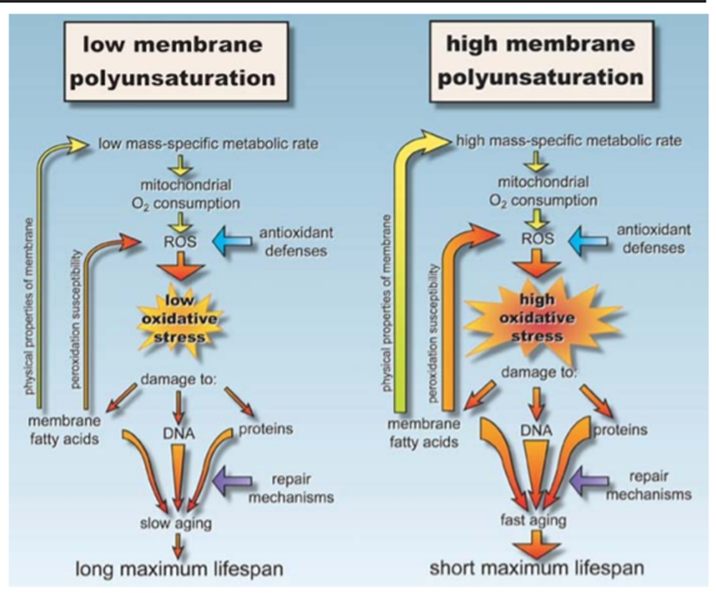
So it is about a merging of the polyunsaturated fatty acid oxidation (MOVO) hypothesis and the oxidative stress theory: the more unsaturated fats (omega-6) someone eats, the more the cell membrane consists of these fats, the more sensitive the membrane is to oxidative stress, with extra damage to cells, DNA and proteins as a result and finally a shorter life as a consequence. This is the MPTA hypothesis. On the basis of this theory Hulbert devised the ‘peroxidation index’, in which the vulnerability of fatty acids is combined with the ratio of fatty acids in the cell membrane to formulate an index that indicates the level of oxidation potential.
Still, in 2008 Hulbert's theory, as he himself concludes, is mainly based on studies with animals and on correlations. It is also still very unclear how the fat ratio in the cell membrane comes about and what the effect of omega-6 intake on this ratio is. So there is as yet no question of a causal link.
"We know that membrane fatty acid composition is regulated, but have almost no idea of the regulatory mechanisms involved, nor how they differ between species. Moreover, I emphasize that the evidence cited in this review linking membrane composition to longevity is correlative. What is now needed are experiments to test if this link is actually causal."
Studies with humans are needed to confirm the theory. So I asked myself, since we are now 14 years further on, whether Hulbert would be further along in confirming his theory. I searched for ‘Hulbert AJ’ and it turns out: he is still publishing. Unfortunately I could not find studies with humans, but in 2015 and 2021 he did two studies to test his hypothesis: a study with cells (in vitro) and a study with bees.
Study with cells: Hulbert investigated fats in the mitochondria (the energy factories in the cell) of muscle, liver and brain cells of mice, pigs and humans. The results show that human cells contain fewer omega-6 fatty acids and therefore oxidise less quickly than cells of mice and pigs (and we live longer). But also that the relationship between cell membrane composition and oxidation is more complicated than omega-6 fatty acid intake and the peroxidation index alone. There are other important fats as well, such as phosphatidylethanolamine and phosphatidylcholine. These are fats that we also get from our food, both animal and plant-based, and that also play an important role in protecting the cells against oxidation.
“This work has shown that the mitochondria of muscle, liver and brain of mice are highly peroxidisable while the tissues of pigs and humans are less likely to peroxidise. Human membranes differed from mouse and pig membranes by containing a lower percentage of PUFA that provides some protection form peroxidation…… Overall, this study shows that the link between membrane lipid composition and peroxidation is more complex than PUFA content and peroxidation index alone. Other elements of membrane composition found to be associated with lifespan were the percentages of alkenyl ethers and plasmalogens, the ratio of phosphatidylcholines (PC) and phosphatidylethanolamines (PE), and the percentage of peroxidation resistant-phospholipids such as PC 16:0_18:1.”
Study with bees: Hulbert decided in 2021 to test his theory in bees. There is a big difference in lifespan between the queen and worker bees. The cells of worker bees also contain many more polyunsaturated fatty acids than those of the queen. Hulbert looked at energy metabolism, the fat ratio in cells and the diet of the bees. The results show that lifespan is not explained by a difference in energy metabolism or by the fatty acid ratio in the cells, even though there is a considerable difference in fatty acid ratio between the cells of the queen and of worker bees. Hulbert adjusted the diet of the bees for the study so that the fatty acid ratio of the cells in bees changed to the same ratio as the cells of the queen. This turned out to have no effect on lifespan.
“Both treatment pairs were successful in experimentally producing the queen-worker differences in membrane peroxidation index. Workers fed the ‘pollen diet’ had membrane peroxidation index similar to the value previously reported for adult workers as did those fed the ‘casein + PUFA’ diet. Worker bees fed the two diets deficient in polyunsaturated fats (i.e. the ‘yeast’ diet and the ‘casein’ diet) had membrane peroxidation index values similar to those previously reported for adult queen bees. This confirms that it is the ingestion of pollen by adult workers after their emergence that is responsible for previously reported increase in membrane peroxidation index of worker bees. Thus, unlike the previous experiments in Calliphora stygia, we have been able to alter the membrane peroxidation index of worker bees by diet manipulation…. Despite the differences in membrane peroxidation index of the workers bees on the different diets there was no consistent pattern that the PUFA-devoid diets which resulted in “queen-like” membrane peroxidation index values, resulted in a longer adult lifespan of worker bees.”
Nutrition science 101: Strength of evidence determines strength of claim
A nutrition scientist always takes the strength of the evidence into account in his claims. This means that, until a large body of evidence supports a claim, claims always come with a ‘maybe’ or ‘could’. Science is usually uncertain and it is important to be sceptical towards people who claim to have all the answers with full certainty. There is a big difference between a possible link between two factors and a causal link. Possible links are countless, but without a body of evidence covering different lines of research (research into the underlying mechanism, observational research with humans, experimental research with humans) one cannot speak of a certain causal link. When claims are made on the basis of a single study, there must be room for uncertainty: one study is never enough for strong claims. The strength of a scientist is keeping room for uncertainty, so that, in the light of new evidence, a theory or hypothesis can always be adjusted. The moment someone is certain, you lose the flexibility to admit that something is different from what was thought before. Nutrition science will always keep moving, for which uncertainty is a crucial factor for progress.
The conclusion
Hulbert has so far, as far as I could find, not been able to investigate his theory with humans. This means it remains a theory based on animal studies and correlations. This makes the strength of the evidence low. It is a fascinating theory that certainly deserves attention, but however plausible Hulbert's theory may be: you cannot generalise a theory based mainly on evidence from research with animals and in vitro research to humans as absolute truth. Moreover, science is not about finding the truth. Scientists form a theory about the truth, after which evidence has to be gathered to strengthen or refute the theory, after which a theory can be adjusted so that it comes closer to the truth. So you cannot go and proclaim a theory as truth. Yet in the video Joseph makes it seem as if the theory has already been proven and provides an explanation for our lifespan.
“Then researchers found another way to predict lifespan that accounts for some of these outlliers like humans and the naked mole rat. They found that if the cells of the animals are more made up of fats that are hard to “oxidize” or break down, they live longer. If the fats in their celss are easy to oxidize, they don’t live as long”
When he makes the bold claims, he shows the graphs that looked at the correlation between the peroxidation index and maximum lifespan. The same peroxidation index that Hulbert, in later research, says does not explain the full correlation between cell membrane composition and oxidation. For the storytelling, Joseph's lack of nuance and his certainty are good, but for the integrity of his translation of scientific literature they are not.
In part 3 of this series we will look, among other things, at the harmful substances that are released when vegetable oils are heated.
What did you think? Let me know in the form of a comment or an email: [email protected]
Have you come across a claim on the internet or social media and are you curious about an assessment of its support? Let me know and I will dive into it!
Do you want to support me and my nutrition science adventure? Share my articles or the podcast on your socials!
Everything you read on this website is my opinion, based on knowledge and experience. There is a good chance that I sometimes overlook something, or that something could be better. I would love to hear it! We do science together.
Glossary
Narrative review: A narrative or systematic review is a literature study that summarises primary research. A systematic review distinguishes itself from a narrative review by its systematic approach. In a systematic review it is fully described how the literature was searched for and how the literature was assessed for quality. In a narrative review this does not happen. Back to where you were.
Body of Evidence: All results of all (types of) studies on a certain subject together. When we want to draw a conclusion about the effect of nutrition on our health, the evidence from all categories of the Pyramid of Evidence has to be combined into one story. In other words, the body of evidence. Back to where you were.