
15 min read
Fakenieuwsvoordiëtisten: No association between saturated fat and diseases of affluence
Nieuwsvoordiëtisten (news for dietitians), a news site for dietitians, dietetics students and professionals in nutrition care, published a news article on 26 January 2022 with the headline ‘No association between saturated fat and diseases of affluence’. It was eagerly picked up on Linkedin with comments like: ‘better late than never’ and ‘I have been saying this for years but the Gezondheidsraad (Health Council) and Voedingscentrum (Netherlands Nutrition Centre) are behind the facts’. But what are the facts that nieuwsvoordiëtisten bases this news on? Does the study tell the same story as the author of the news article? Was the content of the study looked at critically?

Response from Nieuwsvoordiëtisten (NVD) after a group of scientists had sent a signed letter with criticism of NVD: "In the news items of Nieuws voor Diëtisten we give (very) brief summaries of scientific publications or other noteworthy matters that are important to dietitians. Independent, always with references and without opinion or advice. Precisely to inform dietitians broadly about everything that is going on in our field, such as the scientific discussion about saturated fat in peer reviewed scientific journals. Nieuws voor Diëtisten is a neutral messenger in this. (about my blog they said:) We regret the implicit accusation of publishing ‘fake news’, because we find that description not justified and very misplaced, just like the personal, not content-based, criticism of the author of the news item on our site."
The consensus among large government and scientific bodies is that too high an intake of saturated fat raises the risk of cardiovascular disease and that replacing saturated fat with unsaturated fat leads to a lower risk. If the source of the news article by Nieuwsvoordiëtisten contradicts this consensus, then it is interesting to take a closer look. In the news article, Nieuwsvoordiëtisten quotes the authors of a scientific article. They describe the method, the results and the conclusion of the authors, but they give hardly any response to the content of the study. That makes it seem as if there is little to remark on. Especially because you assume that a news site like Nieuwsvoordiëtisten, with a target group of students and nutrition professionals, does not just spread information without thinking. Someone will have looked critically at the content, right? Let's look at the study the news article is based on.
My own bias
During my training I had in-depth course material on the health effects of saturated fat. This course material was in line with the consensus that too high an intake of saturated fat can lead to cardiovascular disease. The advice is therefore to replace saturated fat with unsaturated fat. Replacing it with carbohydrates can just as well lead to an increased risk of cardiovascular disease. Nieuwsvoordiëtisten is a news site that I have followed since my student days and where I like to go for the latest trends in the world of nutrition and health.
A response to the study has been published by Dutch nutrition scientists. Read it here.
Lee et al. carried out a kind of ecological study. The authors examined data on food availability and estimated consumption from 1800 to 2019 in America, using historical government sources and additional public sources. Their primary source is the database of the USDA Economic Research Service (ERS), an institute that analyses every year the supplies of hundreds of unprocessed and processed food products on the American market. On the basis of these data they make estimates of the availability of food per person in America, to identify trends in eating patterns. On the basis of the USDA ERS (and additional databases), the authors made an estimate of how much energy (kcal), nutrients (carbohydrates, fat, protein, alcohol) and food groups (such as dairy, fruit, vegetables, drinks etc.) was consumed per person on average between 1800 and 2019.
In short, Lee et al. found the following:
The consumption of processed and ultra-processed foods rose from under 5 to 60 per cent of the American eating pattern. There were large increases in the availability of sugar, white and wholegrain flour, rice, poultry, eggs, vegetable oils and dairy products. The consumption of saturated fat from animal products fell, while the consumption of vegetable (saturated) fat rose. The incidence of non-communicable diseases (NCDs: metabolic syndrome, type 2 diabetes, cardiovascular disease, cancer and Alzheimer's disease etc.), also called diseases of affluence, rose in the twentieth century in parallel with a rise in the consumption of processed foods such as sugar, refined flour and rice, and vegetable oils. Saturated fat from animal sources is correlated the other way round: it fell while the prevalence and incidence of NCDs rose.
Lee et al. conclude that the food availability data show that the consumption of processed and ultra-processed foods has increased dramatically over the past two centuries, in particular sugar, white flour, white rice, vegetable oils and ready meals. These changes ran parallel with the rising prevalence and incidence of NCDs, while the consumption of animal saturated fat was inversely correlated.
If we then zoom in on the claim (in the title) of both Nieuwsvoordiëtisten and Lee et al.: ‘No association between saturated fat and diseases of affluence’.
They base this on two facts:
(1) In the study by Lee et al. the total saturated fat intake rose by 18 per cent, and according to the authors this can be defined as ‘relatively stable’.
(2) In the same period the prevalence and incidence of diseases of affluence such as metabolic syndrome, type 2 diabetes, cardiovascular disease, cancer and Alzheimer's disease rose.
But Lee et al. go a step further and claim that, besides the consumption of saturated fat staying ‘relatively stable’, the consumption of animal saturated fat fell and the consumption of sugar, refined carbohydrates and calories rose. From this the authors conclude that the increase in the consumption of refined carbohydrates and calories is probably the cause of all diseases of affluence, and not saturated fat.
“Across the twentieth century, rising rates of obesity, diabetes, heart disease, and cancer were associated with stable SFA consumption. Yet, large increases in sugar and refined carbohydrate consumption and more modest increases in total calories make refined carbohydrates and total calories more likely factors than SFA in NCD pathogenesis.”
When I then dive deeper into the study by Lee et al., my nutrition-scientist heart starts to cry a little. I am not going to cover everything I ran into, but I am going to explain a few core pain points.
(1) The discussion and conclusion are not in line with the aim of the study. When we look at the aim of the study, examining the American eating pattern between 1800 and 2019, it never includes that an association, in other words a link, with diseases of affluence would be investigated.
“We reviewed the available data to examine the American diet from 1800 to 2019.”
This is an important shortcoming, because the researchers base all further choices for the following chapters (such as the design of the study in the method) on achieving the aim of the study. So in both the method and the results chapter this association, or the subject of diseases of affluence at all, is never mentioned, even though the association with diseases of affluence is mentioned as a result in the abstract. The association with diseases of affluence only comes up in the discussion. However, this goes against a golden rule of science, a basic rule for students: never cite ‘new’ results in the discussion. The discussion must be based on results from the results chapter. Those are the results that were gathered by the study, by means of the method set out in advance, and the method was in turn set up to achieve the aim of the study. Because diseases of affluence are not dealt with in the aim, and so not in the method, they were never investigated, defined, analysed or tested for an association with the eating pattern of Americans.
Voedingswetenschap 101: De introductie
Anyone who has ever written a study or a thesis knows the structure of an introduction. The aim of the introduction is to outline a problem. The problem is first approached broadly by introducing the topics (what do we already know?). Then a research gap (what do we not know yet?) is named and on that basis the research question is worked towards (what do we want to know?). On the basis of this question an aim can be set (what are we going to investigate). In scientific literature usually only the aim is stated, but it always goes hand in hand with the research question. The aim of a study is to answer a question (testing a hypothesis) by gathering data (results) and then placing these results in context (discussion/conclusion). It is therefore crucial to set a very specific problem, question and aim in the introduction. So that the method, results and discussion follow from an aim set in advance and scientists have a framework for the choices they have to make.
(2) The introduction is chaotic and contains both strange references and incorrect interpretations of sources. For example, in the first paragraph the topics processed food and non-communicable diseases (metabolic syndrome, type 2 diabetes, cardiovascular disease, cancer and Alzheimer's disease) are introduced. But then the authors mainly go into saturated fat consumption as a cause of heart disease. Fat and saturated fat are said to have been wrongly blamed for everything by Ancel Keys and the American Heart Association (AHA). The demonisation of fat and saturated fat is said to be based on the assumption that heart disease was the result of a reduced grain intake and an increased fat/saturated fat intake. In other words: a ‘changing American Diet’.
Ancel Keys
Ancel Keys is famous and notorious because his studies in the 60s laid the basis for the condemnation of saturated fat and cholesterol as a cause of heart disease.
As far as I know, fat and saturated fat have never been portrayed as the bogeyman for all diseases of affluence. I also cannot remember that Ancel thought that a reduced grain consumption is the problem. When I then look at the sources that Lee et al. cite to support the claim: “Ancel Keys' Diet-Heart Hypothesis posited that the mid-nineteenth century heart disease epidemic resulted from “a changing American diet”: increased consumption of fats, especially saturated fatty acids (SFAs), and decreased grain consumption.” I find the following:
Source number 2 : A random review about the plague and how it can be used as a biological weapon. Really what the F*ck.
Source number 3 : A position statement of the AHA from 1961 about fat in our diet and the relationship with heart attacks and strokes. A nicely nuanced piece, if you ask me, in which atherosclerosis is named as the main cause of heart disease. It goes into how complex the relationship is between diet, other lifestyle-related factors and atherosclerosis. So it is not only about the type of fat you eat, but carbohydrates are also named as a cause. Something that does not really support the point ‘fat and saturated fat were blamed for all diseases of affluence’.
“A heart attack, also called coronary thrombosis or myocardial infarction, or just plain "coronary", is almost always caused by atherosclerosis (arteriosclerosis or hardening of the arteries). Stroke, or apoplexy, is often caused by the same condition….. Atherosclerosis is a complex disease of the arteries. It is known that a number of factors influence or are related to its development. Among these factors are a high content in the blood of a type of fat called cholesterol, elevation of blood pressure above normal, presence of diabetes, obesity, and a habit of excessive cigarette smoking. Age, sex and heredity are also important… Evidence gathered from many countries suggests a relationship between the amount and type of fat consumed, the amount of cholesterol in the blood and the reported incidence of coronary artery disease. Study of diets in the United States indicates that they usually contain large amounts of fat which account for approximately 40-45 per cent of the calories. In contrast, many populations in other parts of the world-for example, large groups in Asia, Africa and Latin America-eat food containing barely a third as much fat. The concentrations of cholesterol in the blood of such groups are much less than in those consuming the excess calorie and high-fat diets, and some reports indicate that heart attacks are correspondingly fewer. There are other differences in these diets that may also be of importance, such as the amount and type of protein and carbohydrate”
Source number 8 : a study from 1979 with the title “Dietary goals for the United Stated do you agree?” I cannot find any content for it.
Source number 25 : Finally we have a study by Ancel Keys himself. He describes different lines of evidence for the relationship between saturated fat, cholesterol and heart disease.
“It appears probable that the dietary fats exert their effects not only through affecting the serum cholesterol level and thus influencing atherogenesis but also through effects on the tendency to develop thrombosis. Although the more unsaturated fats may not promote hypercholesteremia, the more powerful effect of the saturated fats is such that blood cholesterol levels cannot be satisfactorily controlled unless the saturated fat intake is reduced. With a judicious choice of fats in the diet, serum cholesterol level can be controlled without imposing extremely low-fat diets. But the use of diets very high in any kind of fats seems undesirable because of the high calorie content of such diets and because of the possibility of undesirable effects on blood coagulation and fibrinolysis.”
I see the reduced grain consumption nowhere. Ancel Keys also never speaks of a ‘changing American diet’. But the aim of the study by Lee et al. does follow from this. Confirming or refuting Ancel Keys' ‘changing American diet’ hypothesis plays an important role in it. This shows in the fact that in the discussion Lee et al. note the refuting of the “changing American diet” as a conclusion.
“The data (of this study) do not support the widely publicized “changing American diet” of increasing animal-derived SFAs over the first 60 years of the twentieth century.”
(3) Something else strange happens here. In the discussion Lee et al. suddenly make a switch from total saturated fat to animal saturated fat, only to switch back to total saturated fat at times. So the ‘changing American diet’ hypothesis of Ancel Keys would only be about the rise in animal saturated fat. However, in the sources from the AHA or Ancel Keys just mentioned I have nowhere seen a distinction between saturated fatty acids (animal versus vegetable).
(4) Associations are wrongly spoken of. According to Lee et al. the ‘changing American diet’ cannot be right, because firstly the results of this study show that the consumption of various sources of animal saturated fat has fallen and secondly this runs parallel with a rise in the prevalence and incidence of all non-communicable diseases. Therefore saturated fat from animal products would have been wrongly blamed for all diseases of affluence for decades. Although I cannot find anywhere what they base this on.
“From 1800 to 2000, red meat consumption declined by 44%, fluid and cream dairy consumption declined by 48%, and egg consumption increased by 241%. From 1909 to 2010, lard consumption declined 78% and butter declined 68%, while margarine increased 192%, shortening increased 91%, and salad and cooking oils increase 329%. Americans consumed up to 70% fewer SFAs from animal sources by the end of the century, as obesity and diabetes epidemics emerged, alongside an increased incidence of NCDs such as cancer and heart disease.”
But can you speak of associations or links on the basis of this line of evidence? All that Lee et al. did is analyse the eating pattern of the average American to find trends in the eating pattern. Then these trends were laid next to graphs of diseases of affluence to be able to say ‘hey look, these both rise or these both do not rise or these fall and rise together.’ But showing associations in this way gives two big problems.
Firstly, when we look at the graph of cardiovascular disease, we see that there is no rising line in it at all.
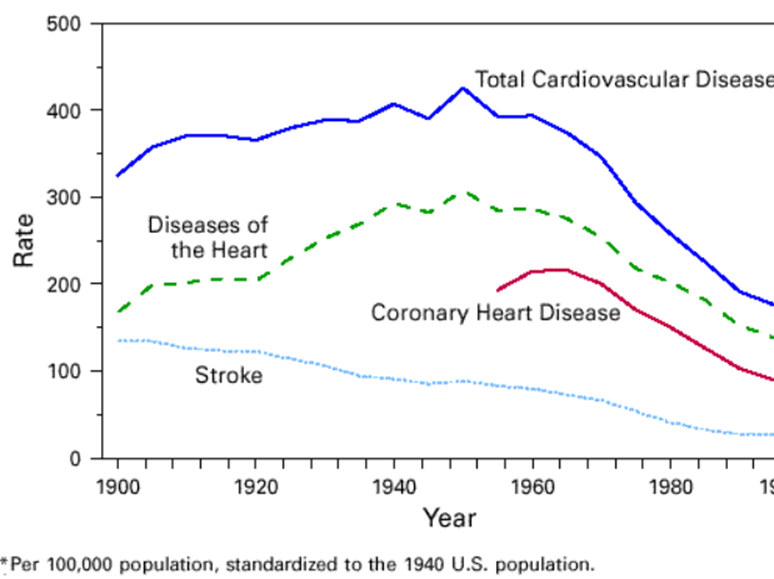
Cardiovascular disease has been falling since about 1950. When we then look at the results of Lee et al., we see that the fall goes together with the fall in animal saturated fat intake. Which is the opposite of what Lee et al. suggest.
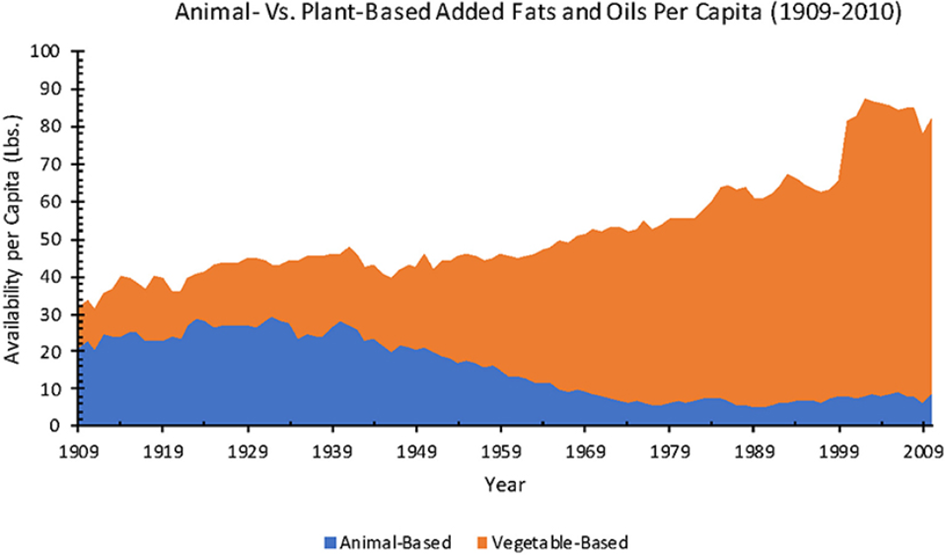
Secondly, with this way of investigating associations you get very rough associations for which you have no idea whether they are due to chance or whether other explanatory factors are at play. There are many things that correlate with each other about which you can still have your doubts whether they really have anything to do with each other, such as: the more ice creams are eaten, the more murders are committed, or the poorer the country you live in, the bigger the penis of the men.
A website with many nice examples of correlations.
That is why we use statistical tests to calculate the chance of coincidence and to be able to take confounding factors into account. That was not used in this study.
Strength of evidence
So how strong is the evidence for the claim ‘no association between saturated fat and diseases of affluence’?
There is no evidence. This study never investigated an association between diet and diseases of affluence.
All this study shows are trends, on the basis of limited data, in the availability of food over the past 200 years, from which an estimate is made of the eating pattern of an average American. All claims about associations based on this study are speculative guessing.
Conclusion
The writing of this study feels chaotic and I therefore found it hard to write a short summary of it. The study strays far from the core: describing trends in the eating pattern of the average American. The aim of the research does not flow nicely from the introduction, which in turn is full of assumptions without good references or studies that have been misinterpreted. In addition, the discussion and conclusion are not a logical consequence of the aim, the method and the results. There is a sudden switch from saturated fat to animal saturated fat (and the other way round) without support, but many different diseases are also taken together (as diseases of affluence) as well as treated individually, none of which were included in the aim, method or results of the study. This makes the study hard to read and complicated. It feels as if the authors started the study with a biased love for saturated fat, but that is of course speculation.
Confirmation bias
Then I am still left with quite a few questions. Why were these points not raised by Nieuwsvoordiëtisten? Why was the title copied without thinking? How is it possible that nobody looked critically at the content of the study?
Response from Nieuwsvoordiëtisten
"Thank you for your email, in which you respond to our reporting on saturated fat and in particular to 2 news items about it of 21 September and 26 January. In the news items of Nieuws voor Diëtisten we give (very) brief summaries of scientific publications or other noteworthy matters that are important to dietitians. Independent, always with references and without opinion or advice. Precisely to inform dietitians broadly about everything that is going on in our field, such as the scientific discussion about saturated fat in peer reviewed scientific journals. Nieuws voor Diëtisten is a neutral messenger in this.
Of course discussion about the quality of these studies and the conclusions the researchers draw is valuable, precisely so that as a dietitian you can assess everything from several sides. Following your email we have therefore now included a note at the bottom of the news item “Geen verband tussen verzadigd vet en hart- en vaatziekten?” (No association between saturated fat and cardiovascular disease?), in which we refer to the criticism you have of the study. A few months ago we had already done the same for the news item from the end of January “Geen verband tussen verzadigd vet en welvaartsziekten?” (No association between saturated fat and diseases of affluence?). A link is included there to the commentary published in the same scientific journal by, among others, Wendy Walrabenstein.
We have only not included a link to the blog mentioned in your email “Fake nieuws voor diëtisten: Geen verband tussen verzadigd vet en welvaartsziekten”. We regret the implicit accusation of publishing ‘fake news’, because we find that description not justified and very misplaced, just like the personal, not content-based, criticism of the author of the news item on our site. "
The only criticism the study received was that no causal association can be shown with this type of research. But an association was never investigated….
To me it seems a perfect example of confirmation bias. Confirmation bias is the tendency to attach value and attention mainly to information that confirms existing beliefs. This makes a person no longer critical of the information he or she reads. The writer of the news article is a fellow nutrition scientist. After a small google search her beliefs about saturated fatty acid become clear. I ended up at an article from the Dutch Tijdschrift voor Voeding en Diëtetiek (Journal of Nutrition and Dietetics): ‘Is maximaal 10 energie% verzadigd vet een goede norm?’
Here the nutrition scientist was asked to respond to a study (the PURE study) that found no association between saturated fat and various diseases. Here too the nutrition scientist does not go into the content of the study and uses the study to make her belief about saturated fat known:
“A lot of health gain can indeed be achieved with nutrition. But does improving the fatty acid composition deserve the highest priority there? I don't think so. And the PURE study also turns out to achieve little….. Saturated fat is not as bad as was once thought.” (translated from Dutch)
A missed opportunity if you ask me. I think the strength of nutrition scientists lies precisely in assessing literature instead of taking over conclusions without thinking, like other ‘experts’ on the internet. As nutrition scientists we precisely want to reduce the noise in information about food and health, not increase it.
The results of Lee et al. are in line with the beliefs of the nutrition scientist. That may explain why the content of the study was never looked at critically. So it turns out that confirmation bias also happens to scientists, because scientists are people too.
What did you think? Let me know in the form of a comment or an email: [email protected]
Have you come across a claim on the internet or social media and are you curious about an assessment of how well it is supported, let me know and I will dive into it!
Everything you read on this website is my opinion based on knowledge and experience. There is a good chance that I sometimes overlook something, or that something can be done better. I would love to hear it! We do science together.
Glossary
Processed food: Processing of food changes the food from how it occurs in nature. Processed food is often made by adding salt, oil, sugar or other natural additives. Think of canned tuna or canned vegetables, fruit or baked bread. Go back to where you were.
Ultra-processed food: Processing of food changes the food from how it occurs in nature. Ultra-processed food is heavily processed with added ingredients such as sugar, salt, fat and artificial sweeteners/preservatives. In addition they are made from refined sugars and hydrogenated fats, which removes most of the fibre, vitamins and minerals. Examples are soft drinks, hot dogs, fast food, biscuits, cake, snacks and pizzas. Go back to where you were.
Prevalence: How often a certain disease/condition occurs in a population. Go back to where you were.
Incidence: Indicates how many new cases a certain disease/condition has in a population in a certain period of time. Go back to where you were.
Causal: When one factor is the direct cause of another factor, we call that a causal association. Go back to where you were.
Confounding: A confounder is a (third) factor that causes a distortion of a relationship between two other factors. It gives a wrong impression. For example, it can make it seem as if there is an association or, on the contrary, not. A confounder has a relationship with both the explanatory factor (determinant) and the outcome, but is not on the causal path. By including confounders in a statistical analysis, the direct association between an explanatory factor and an outcome can still be investigated. Go back to where you were.
Consensus: Consensus is when a group or community has jointly reached agreement on a certain subject. Go back to where you were.
Association/correlation: The relationship between two factors (a link). Go back to where you were.