
22 min read
Plant-based or plant-malignant oils? (Part 1)
Vegetable oils are unhealthy. Especially refined vegetable oils that are high in omega-6 fatty acids. These oils contain dangerous chemicals, disrupt our fatty acid balance and are prone to oxidation. At least, that is what various dietitians, nutrition experts, doctors and investigative journalists (and many people in the orthomolecular/ancestral nutrition corner) are convinced of. This is often claimed without thinking, but sometimes scientific research is cited as well. Anyone who dives into the scientific literature behind the dangers of vegetable oils gets tangled in a web of reviews with nice stories about mechanisms and clinical studies. How strong is the scientific support for the dangers of vegetable oils? Are vegetable oils actually plant-malignant oils?

To be specific, the big villains are refined vegetable oils that contain a relatively large amount of the polyunsaturated omega-6 fatty acid linoleic acid. Examples are corn oil and soybean oil, but also seed oils such as rapeseed oil and sunflower oil. Still, the Voedingscentrum recommends omega-6 fatty acids such as linoleic acid as part of a healthy diet, without a maximum amount being set.
“Omega-6 fatty acids are polyunsaturated fatty acids. The best-known omega-6 fatty acid is linoleic acid. Omega-6 fatty acids lower the risk of cardiovascular disease (CVD) and fit into a healthy diet. Linoleic acid is found in vegetable oils. The body cannot make linoleic acid itself and so has to get it from food”, according to the Voedingscentrum. (translated from Dutch)
Because vegetable oils, such as sunflower oil, are cheap and have a healthy image, they are used for baking/frying and you find them in many processed products. Just look at the label of half-fat margarine, breakfast cereals, crisps, salads and other (ultra-)processed food. So if they are in many processed products, and (ultra-)processed products are often not good for our health, is that because of the vegetable oils in them? Is the healthy image justified at all?
Vegetable oils and oxidative stress
An important theory for the harmful effects of vegetable oils is the polyunsaturated fatty acid oxidation hypothesis, or as I will call it: the MOVO hypothesis. The MOVO hypothesis states that polyunsaturated omega-6 fatty acids, such as linoleic acid, are very prone to oxidation. Oxidation is the result of exposure to oxygen, which causes oxidative stress. An example of oxidation is when iron rusts or when an apple turns brown. However, oxidation and oxidative stress also occur in the body. Important players in this story are free radicals. Free radicals lack an electron and are therefore unstable molecules. This electron is taken away by oxygen. This means free radicals are formed by our metabolism (which needs oxygen), but they can also arise from stress, air pollution, radioactive radiation and inflammation. They are also made by the immune system, for example to kill bacteria (so a low amount is beneficial). The counterparts of free radicals are antioxidants. Well-known antioxidants are vitamin E and C. These molecules have one electron too many, which they can lend to a free radical, and that makes the molecule stable again. When there is an imbalance between the amount of free radicals and antioxidants in the body, oxidative stress arises: an excess of free radicals damages the proteins, fats and DNA of our cells. With as possible result long-term disease such as cancer and cardiovascular disease. In short, to prevent oxidative stress you had better avoid linoleic acid as much as possible, for two reasons:
(1) Oils oxidise when we heat them during the production process or when we use them for baking/frying. This creates harmful substances that we then take in through our food.
(2) The cells our body is made of are made of fats. The ratio of fats our cells are made of is based on the ratio of fats we eat. The more linoleic acid we eat, the more our cells are made of linoleic acid. The more our cells are made of linoleic acid, the more prone our cells are to oxidative stress.
As far as I am concerned, the hypothesis sounds very logical. That polyunsaturated fatty acids are more prone to oxidation is apparently general chemical knowledge. Also, nobody denies the harmful effects of oxidative stress. That is why it is important that the science behind the MOVO hypothesis is taken seriously. Something I see few people at organisations such as the Voedingscentrum do. I also did not learn it during my studies in Nutrition and Dietetics or Health Sciences. Many scientists and dietitians side with the status quo and dismiss the hypothesis, or throw around scientific literature that would prove the opposite. This made me curious. After all, supporters of the MOVO hypothesis also use scientific literature. What does the science behind this hypothesis look like? How strong is the evidence? Are the dietary guidelines on vegetable oils fooling us?
My own bias
I think that everything that 'too' stands for is not good. This means that getting too much vegetable oil may not be good for health. But what 'too much' is, I find hard to say. I know that processed products are the biggest source of vegetable oil for many people and I am convinced that eating heavily processed products is not good for health. Is this because of the vegetable oils in them? I think not. I think the negative health effects of processed products come more from the low amount of vitamins, minerals and fibre. The MOVO hypothesis seems a bit too simplistic to me.
The starting point: The $100 billion dollar ingredient

Source: ‘The $100 Billion Dollar Ingredient making your Food Toxic’ – YouTube channel: What i’ve learned
No, a YouTube video is not scientific evidence. But to be able to dive into scientific literature without letting my own convictions take over, I need a starting point. This starting point has to begin with people who put vegetable oils (Dutch: plantaardige oliën) in the doghouse and give a clear overview of the literature behind the MOVO hypothesis. Why begin with this YouTube video, then? Because I have followed Joseph of What i’ve learned for years and he tells an incredibly strong story about the harmful effects of vegetable oils. (if you have not seen the video yet, I advise you to do so first) He also cites a great deal of scientific research to support his story. As I write this, the YouTube channel has almost 2 million subscribers and contains a lot of videos about nutrition and health. His video about vegetable oils got more than 600 thousand views in two weeks and the whole comment section agrees with him. I have also seen several people share his video on social media. Does Joseph then really make a good point? Does he see things the authorities do not see or do not want to see? And what about the evidence he provides, has anyone looked critically at its content? Or is his channel one big confirmation bubble? Let's begin at the beginning: who is Joseph of What i’ve learned?
Who is What i've learned?
On 28 March 2020 Joseph Everett gave an interview to the Japantimes. The 30-year-old American lives in Japan and works full time on his YouTube channel. In 2016 he started the channel, which now has around 2 million subscribers. According to Joseph, his videos are about subjects where "general knowledge on the subject is not in line with the current state of science, so the facts tell a very different story than is often told by authorities", according to Joseph. He focuses mainly on nutrition and health and hopes that people will make better choices through the information in his videos. He puts around 40 to 70 hours into a video, in which he interprets and translates scientific research. I have to say, the quality of his videos is top and his storytelling is very, very strong. Which explains the popularity of his channel. Joseph himself follows a low-carb/ketogenic diet, is sceptical of the healthy image of a vegan diet and fasts regularly. This is also clear from his videos with titles such as 'Eating less meat won’t save the planet. Here’s why.', 'Is meat bad for you?', 'why we need “bad” LDL cholesterol' and 'longevity & why I eat once a day'. Despite his interest in nutrition science he has no medical or scientific training, but according to him that is not necessary either.
“I’ve gotten comments like, “Why should we trust you? How do we know you’re not biased?” I’m not asking you to trust me, I’m just showing the data and the reasoning behind ideas. You can make your own decisions based on that.”
Diving into the evidence
So that is what I am going to do. In the coming series (of around four articles) I dive into the evidence in the video about the effects of vegetable oils on our health. His storytelling is strong, is his evidence just as strong?
To look at the evidence step by step, I have taken six claims plus scientific literature from his video. Among other things, I looked at the correlations between the consumption of vegetable oils and diseases of affluence, at whether people who eat more vegetable oils die sooner, at whether drinking frying fat is bad for you, and at what the situation is with the harmful substances released when vegetable oils are heated.
First we will look at the remarkable correlation between vegetable oils and diseases of affluence. What is the explanation for the correlations between the rise in consumption of vegetable oils (rich in omega-6 fatty acid) and the rise in diseases of affluence between 1940 and 2020?
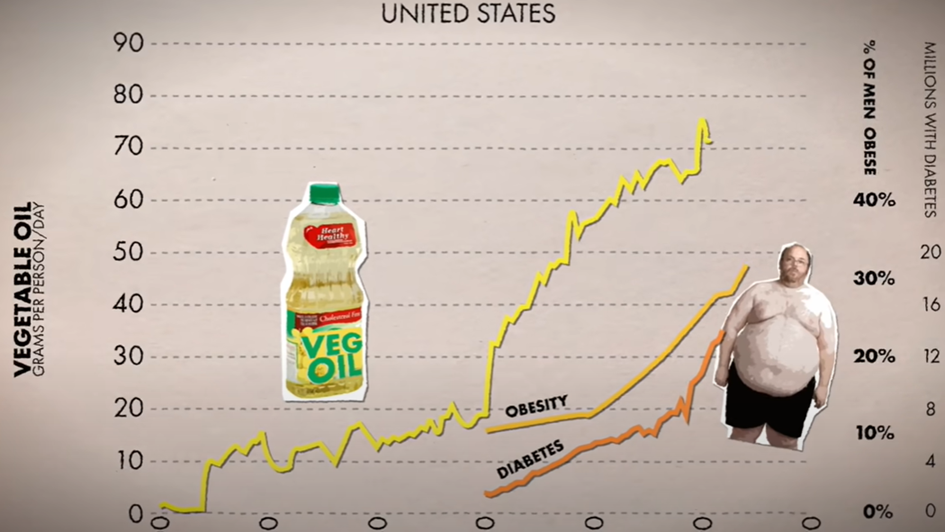
Claim: There is a strong correlation between vegetable oils (rich in omega-6 fatty acids) and diseases of affluence such as cardiovascular disease, overweight and type 2 diabetes. According to some doctors and scientists, the omega-6 fatty acid linoleic acid is THE cause of those health problems.
As Joseph (fortunately) points out himself in his video, a correlation does not yet mean there is an association. He shows several studies in his video when he claims that there are surely scientists who see this correlation as a causal link. The first study is a review of the relationship between vegetable oils and coronary heart disease (cardiovascular disease).
Linoleic acid and coronary heart disease
In this narrative review by DiNicolantonio & O’Keefe (D&O for short) the ‘The oxidized lionleic acid hypothesis’, in other words the MOVO hypothesis, is explained and they set out why the hypothesis explains the correlation with coronary heart disease. It is interesting to note here that in my critical piece about Nieuwsvoordiëtisten I actually showed that there is no rise in cardiovascular disease, but let's leave that for now. The authors give some history of the hypothesis, explain the mechanisms and tell about clinical studies focused on vegetable oils and coronary heart disease (cardiovascular disease). In box 1 ‘Evidence implicating omega-6-rich vegetable oils as a causative factor in atherosclerosis and coronary heart disease’ you find the main points of the hypothesis summarised, listed and supported with sources.
The authors' conclusion is clear: research at all levels shows that the cause of coronary heart disease is not the ‘LDL cholesterol is a Loser and HDL cholesterol is a Hero’ story of the Voedingscentrum. (Which, by the way, is in line with practically all other (worldwide) health bodies such as the European Atherosclerosis Society (EAS) or the American Heart Association (AHA).) The cause of coronary heart disease is the oxidation of LDL cholesterol particles. The more linoleic acid (omega-6 fatty acids) someone eats, the more prone the body is to oxidation, the more oxidised LDL someone has in their body, the greater the chance of cardiovascular disease. In other words the MOVO hypothesis.
“In summary, numerous lines of evidence show that the omega-6 polyunsaturated fat linoleic acid promotes oxidative stres, oxidised LDL, chronic low-grade inflammation and atherosclerosis, and is likely a major dietary culprit for causing CHD, especially when consumed in the form of industrial seed oils commonly referred to as ‘vegetable oils’.”
LDL cholesterol is a loser and HDL cholesterol is a Hero story
“Cholesterol is a fat-like substance that your body needs as a building block. Your liver makes most of the cholesterol itself.
The blood transports cholesterol by binding it to certain proteins. These proteins are called lipoproteins. There are different kinds of lipoproteins: high-density lipoprotein, known as 'HDL' and low-density lipoprotein, known as 'LDL'. The combination of an LDL and cholesterol is called LDL cholesterol.
In 2 cases the cholesterol in your blood can increase the risk of cardiovascular disease: if the cholesterol level is too high and if the ratio between the kinds of LDL cholesterol and HDL cholesterol is off.
Above all, an off ratio gives a higher risk. You can improve the ratio between LDL and HDL cholesterol by being moderate with saturated fat and replacing saturated fat with unsaturated fat.” - Voedingscentrum
To be clear, as you can see in the figure below, the current consensus of authorities such as the EAS is also that oxidative stress and the oxidation of LDL is an important step in the causal link between LDL and atherosclerosis. However, the EAS never wastes a word on the MOVO hypothesis -- the word linoleic acid or omega-6 does not appear in their pieces.
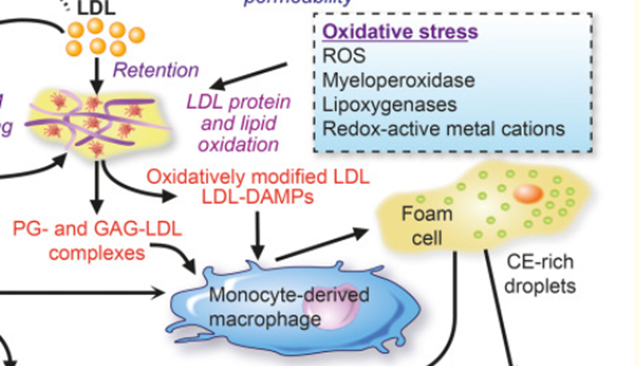
Let us assume that the mechanism behind the MOVO hypothesis is plausible and that the parts plus sources of the mechanism in the narrative review are correct. Then mainly one question remains: Is it true that clinical research confirms the MOVO hypothesis? Is there more cardiovascular disease in people with a high omega-6 fatty acid intake? Do these people also die sooner? According to D&O yes, but when we look at the studies they cite it turns out not to be that simple.
Research with people
In box 1 D&O conclude that a meta-analysis of randomised controlled trials with people shows that replacing saturated fat and trans fat with linoleic acid increases the risk of death (from cardiovascular disease).
“A meta-analysis of randomised controlled trials in humans found that when saturated fat plus trans-fat is replaced with omega-6 fat (high in linoleic acid), there is an increase in all-cause mortality, ischaemic heart disease mortality and cardiovascular mortality.”
They then highlight several individual studies that investigated the effect of omega-6 on cardiovascular disease. It is not clear whether these are all the clinical studies ever carried out on the subject. Or on the basis of which criteria these studies were selected. So you have no idea whether the researchers consciously or unconsciously left out certain studies. Maybe they left out studies with results that go against the narrative. This is the downside of a narrative review compared with a systematic review. Researchers are not transparent about the method of their search and that brings problems with it. When we then dive deeper into the first study they cite, there are some remarkable findings.
MARGARIN study
It concerns the MARGARIN study from Groningen by Bemelmans et al. from 2002. Researchers at the University of Groningen wondered whether a diet rich in linolenic acid (plant-based omega 3) is better for health than linoleic acid (omega 6). They set up an RCT in which people received either a margarine enriched with omega 6 or a margarine enriched with omega 3. Besides the margarine, the groups also received education about different healthy diets: a Mediterranean diet or a diet according to the Goede Voeding guidelines of the Gezondheidsraad (Health Council of the Netherlands). From 1997 the people were followed for around 2 years with three follow-up measurements in which their diet was recorded, but many measurements aimed at cardiovascular disease were also carried out. The aim of the MARGARIN study was to compare the effect of an increased omega-3 intake with an increased omega-6 intake.
“We assessed the effects of an increased ALA (omega-3) intake, against an LA (omega-6)-rich background diet”, according to bemmelmans et al.
D&O focus on a few results from the MARGARIN study. They claim that, compared with the omega-6 margarine, the omega-3 margarine lowered C-reactive protein (CRP) significantly. Since CRP is independently associated with the risk of CVD, the MAGARAIN study suggests, according to D&O, that omega-6 consumption may increase the risk of CVD.
“Compared with 0.3% ALA margarine (ie, the LA-enriched margarine), the 15% ALA margarine significantly lowered inflammation (C reactive protein (CRP), net difference after 1 year=−0.53 mg/L and after 2 years=−0.56 mg/L (p<0.05)) despite being given on top of a LA-rich diet. CRP was reduced after 1 year (−0.10 mg/L) but no change after 2 years in the ALA group, whereas CRP rose in the LA group (+0.2 and +0.3 mg/L, respectively). Since CRP has been independently associated with increased CV risk, this study suggests that ALA may reduce whereas LA may increase the risk of CVD.”
In addition, the people in the omega-6 group would have higher fibrinogen blood levels (also a risk factor for cardiovascular disease) and the Groningen study would show a higher mortality from cardiovascular disease in the omega-6 group, despite a lowering of cholesterol.
Correction: Earlier I said that the researchers had not looked at the effect within groups: "As I said before, the aim of the MARGARIN study was to compare the effect of an increased omega-3 intake with an increased omega-6 intake--and the aim determines the method of the study. The analysis this study therefore carried out is analysing the difference between the two groups, not the difference between baseline and the follow-up measurements." However, the researchers used an ANCOVA analysis, which means the researchers did do this. This means that despite the spread within the groups there was a significantly lower CRP in the omega-3 group compared with the omega-6 group. This can of course be purely the result of increasing the omega-3 intake and have nothing to do with omega 6.
The study does indeed show that the omega-3 group has a lower CRP blood value of -0.53 mg/L after one year and -0.56 mg/L after two years. The study also shows that the omega-6 group shows a median increase of +0.2 after one year and 0.3 after two years. D&O also do not mention the considerable spread in CRP increase (from -0.5 to +1.4) within the omega-6 group – and spread is important! With a median, an interquartile range (IQR) is reported. The median is the middle value when all values are put in order one after another. The IQR covers one quartile (25%) to the left and one quartile (25%) to the right of the median. Fifty percent of the people in the omega-6 group thus had a spread of - 0.5 to +1.4 in CRP. Far from all individuals therefore had an increase in CRP.
In addition I am left with questions. Let's suppose that omega-6 consumption does indeed increase CRP in the body. Is a CRP blood value increase of 0.3 mg/L clinically relevant? What does this do to my risk of CVD? Because I happen to know that physical activity can also increase CRP. But nobody claims that physical activity is unhealthy. Is CRP really an independent predictor of CVD? Does an increase in CRP make omega 6 healthy or unhealthy? D&O do not give this context. This leaves a critical reader with more questions than answers. So I went looking for answers in the source reference that D&O give for their claims about CRP: The MARGARIN study. The same study they take the result from. Strange. The Groningen scientists also state that CRP is an independent predictor of cardiovascular disease, they refer to research by Paul Ridker. Can the research of Paul Ridker then answer my question for context? Then it certainly can. However, this context is for enthusiasts and secondary to this story.
Research by Paul Ridker
Paul Ridker is a professor at Harvard Medical School and an epidemiologist specialised in cardiovascular disease. He has done a large part of his research on the relationship between inflammation and atherosclerosis (hardening of the arteries). To keep my story short I will focus on a few findings from Ridker's research:
-
CRP is a strong independent predictor of future cardiovascular disease.
-
Important cut-off values are below 1, between 1 and 3 and above 3 mg/L, where the risk of cardiovascular disease rises exponentially as the CRP value rises. People with chronic diseases such as cancer have CRP values above 10. (These people were therefore excluded from the research by Bemelmans et al.)
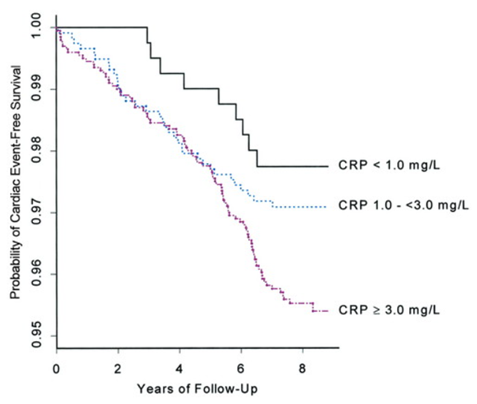
- The risk of cardiovascular disease depends strongly on a combination of CRP and other risk factors for cardiovascular disease such as LDL and criteria of the metabolic syndrome (high triglycerides (fat), low HDL cholesterol, high blood pressure, obesity (based on waist circumference) and high blood sugar).
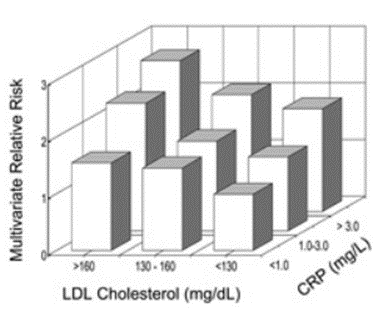
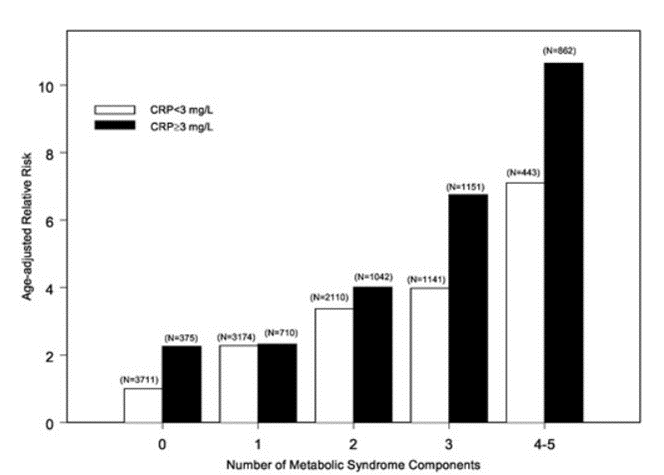
This shows that the effect of CRP depends a lot on someone's baseline CRP value and other risk factors. If someone rises from 2 to 2.3 mg/L or someone is otherwise physically healthy, you can ask yourself how relevant this is.
In addition, they leave out that Bemelmans et al. found no difference in the risk of coronary heart disease and atherosclerosis between the omega-6 and omega-3 groups.
“No significant difference existed in 10-y estimated IHD risk…. The 2-y progression rate of the mean carotid IMT (ALA and LA: +0.05 mm) and femoral IMT (ALA:+0.05 mm; LA:+0.04 mm) was similar, when adjusted for confounding variable.”
And that they found no significant difference in oxidised LDL. Which contradicts the mechanism put forward in the review for the relationship between omega-6 and cardiovascular disease.
"No significant effects were observed in oxidized LDL antibodies, and levels of sICAM-1, interleukins 6 and 10."
Bemmelman et al. therefore concluded that supplementation with both omega 3 and omega 6 gives a lower risk of heart disease.
“Our results show that the effects of ALA supplementation on estimated IHD risk are at least similar to, or even more beneficial than, those of a standard LA-rich diet.”
Still, on the basis of very low (non-significant) numbers, D&O conclude that omega-6 intake showed an increase in mortality from cardiovascular disease.
“The group provided the LA-enriched margarine had a significantly improved total cholesterol (TC):HDL ratio versus the ALA-enriched margarine, despite the fact there was an increase in cardiovascular events/deaths in those assigned to the LA-enriched margarine. Indeed, the number of strokes, myocardial infarctions and cardiovascular deaths was seven in patients given the LA-enriched margarine group versus only one in those given the ALA-enriched margarine.”
These are very low numbers (7 versus 1 case), which is why no significant difference was found. Still, D&O put this study under the heading: 'Linoleic acid increases cardiovascular events versus alpha-linolenic acid in a 2-year clinical study.'
In short, D&O's conclusions are far too firm, with results that go against their narrative left out. To me it feels like deliberate misleading or unconscious confirmation bias.
The Ramsen Trilogy
We go back to the meta-analysis of randomised controlled trials from which it would appear that replacing saturated fat and trans fat with vegetable oils increases the risk of death (from cardiovascular disease). A claim that runs directly against the claims of the Goede Voeding guidelines of the Gezondheidsraad and all other health bodies worldwide. The meta-analysis is part of a series of meta-analyses carried out by the same first author: Christopher Ramsen.
Dr. Christopher Ramsen is not just any scientist. He is a researcher at the NIH (National Institutes of Health) of the US federal government and specialised in fat oxidation. In less than ten years Ramsen has published three meta-analyses based on Randomized Controlled Trials (RCTs) aimed at replacing saturated fat with vegetable oils. Ramsen and his research play an important role in both the narrative review by D&O and Joseph's video. Ramsen went in search of old data from leading studies on the relationship between fats and cardiovascular disease: The Sydney Diet Heart Study and Minnesota Heart Survey. Both were carried out around the 60s, when cardiovascular disease was already a big problem, and are experimental in nature. During his search he found old data from these studies that had not been used in the publications before. He carried out new analyses and used the new results in re-evaluations of the individual studies and meta-analyses.

To begin at the beginning: Ramsen publishes his first meta-analysis in 2010. This meta-analysis is aimed at the effect of replacing saturated fat and/or trans fat with omega 6 or a combination of omega 3 and omega 6 on heart attacks, (death from) coronary heart disease and/or all-cause mortality. In the end seven studies are included in the analysis, consisting of eight databases (one study has separate databases for men and women). Four of the seven studies replace saturated and trans fats with a combination of omega 3 and omega 6 and the other three only with omega 6. In 2013, after Ramsen has found the new old data, he publishes an update of his meta-analysis in which the Sydney study plus new data is included. Finally, in 2016 Ramsen publishes his last meta-analysis together with new results from the Minnesota study. I will come back to the specific content of the meta-analyses in another part of this series. For now I will stay on the surface and focus on the results, conclusions and interpretation of them. That is where it already went wrong with the MARGIRINE study. I have put it all in a row for you:
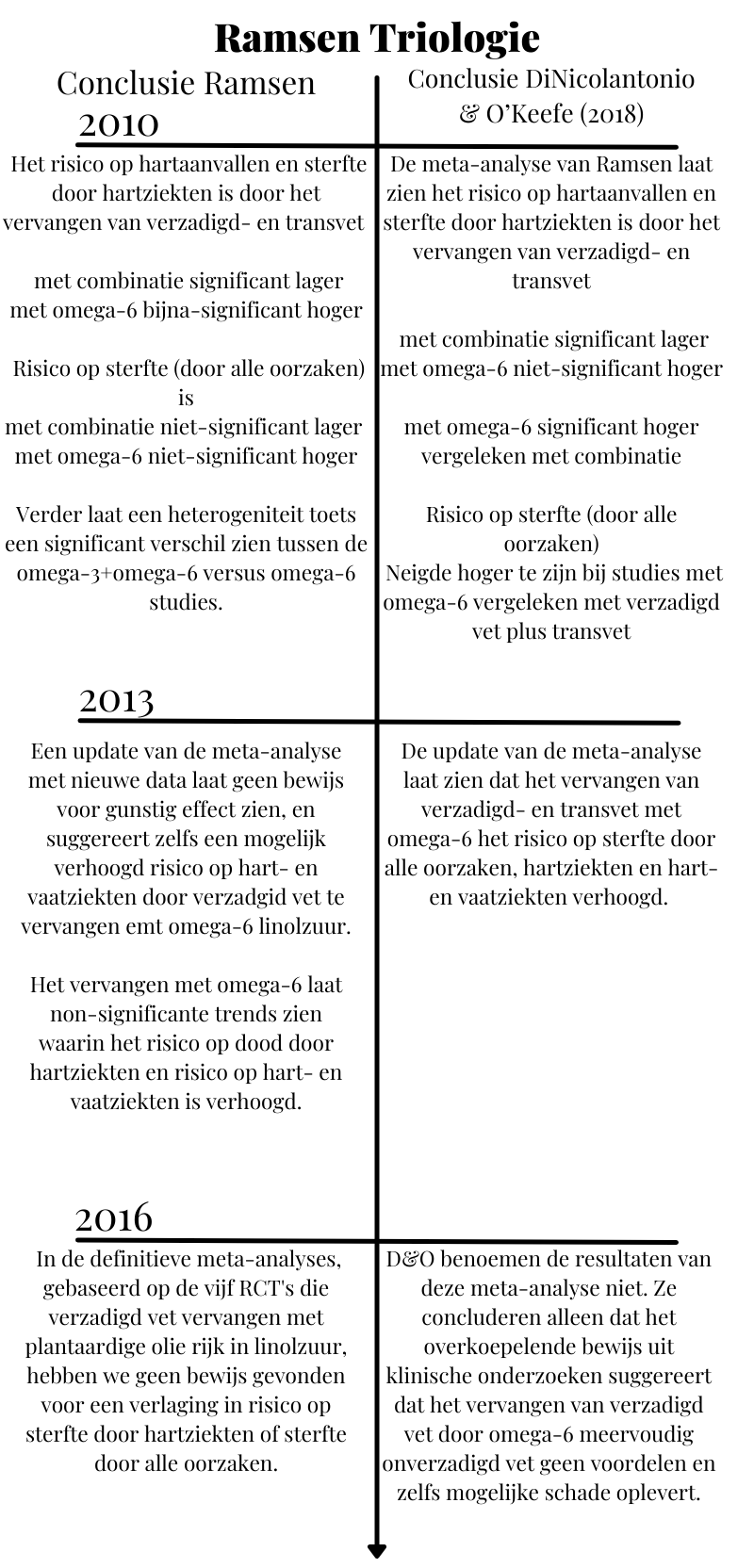
What stands out? First, that the results of the meta-analyses hardly change. Replacing saturated and trans fat with a combination of omega 3 and omega 6 turns out to be a top idea in all meta-analyses -- your risk of cardiovascular disease goes down significantly. Even though both Ramsen and D&O pay little attention to this in the second and third meta-analysis, this seems to me an important result. In addition, the effect of omega 6 stays practically the same in all meta-analyses: a non-significant harmful effect. Also called a trend by Ramsen. Ramsen stays careful in his conclusions, for example he states that it is not significant, or he skirts around it by phrasing it as “there is no evidence for a protective effect of omega-6 fatty acids.” This is of course not entirely true, because in combination with omega 3 it certainly does show a protective effect, and they did not investigate what the effect of omega 3 alone is.
Second, it stands out that D&O use little nuance in their conclusions and here again make wrong interpretations. On the basis of the 2013 meta-analyses they conclude that there is an increased risk, full stop. No doubt, no caution.
“In an updated meta-analysis published in 2013, replacing saturated fat plus trans-fat with omega-6 PUFA was found to increase all-cause mortality as well as deaths from CHD and deaths from cardiovascular disease.”
They also claim that the 2010 meta-analysis shows that the risk of non-fatal heart failure plus death from coronary heart disease was significantly increased in studies that increased omega-6 intake compared with a combination of omega 3 and omega 6.
“The risk of non-fatal MI plus CHD death was significantly increased in trials of increased omega-6 intake compared with trials of mixed omega-3/omega-6 PUFA (p=0.02).”
They base this on the heterogeneity test of the meta-analysis. This is worrying, because that is not what a heterogeneity test tests. It tests, as Ramsen also roughly interprets it, whether there is a significant difference between the (results of) studies included in the meta-analysis itself. These differences are then not due to chance, but for example to differences in the methodological designs (such as a different supplement: omega 6 vs a combination of omega 6 and omega 3) of the studies. Because of which they really investigate different things and have to be placed in sub-analyses, as Ramsen also did. This only confirms that a combination of omega 3 and omega 6 has a significantly different effect than omega 6 alone. This says nothing about the significance of the effect of omega 6 on the outcomes. Something that D&O do suggest, either deliberately (misleading) or unconsciously (insufficient knowledge).
Third, I notice that from the second meta-analysis on Ramsen suddenly only speaks of replacing saturated fat and no longer of trans fats. It is not clear why and how that works within the studies included in the meta-analyses. It is an important point because trans fats are recognised by almost everyone as an independent risk factor for cardiovascular disease.
Nutrition science 101: Significance
(Statistical) significance, also called P(robability) value, stands for the chance that the found result was found while the null hypothesis (there is no effect or difference) cannot be rejected. In other words, significance stands for the chance that the found result is based on chance and when this chance is small enough (smaller than 5 percent) the null hypothesis can be rejected and the alternative hypothesis (there is a difference or effect) accepted. Another way to look at the significance of the result is the confidence interval. The confidence interval is a spread around a result that indicates how certain we are of the effect. When the spread shows either entirely a negative effect or entirely a positive effect, we can speak of a significant effect.
Example confidence interval
Ramsen combined several studies that replace saturated fat with a combination of omega 3 plus omega 6 or omega 6 alone and looked at the effect on death from cardiovascular disease and found the following effects:
Replaced with combination: 0.79 (CI 95%: 0.63 – 0.99)
Replaced with omega 6 only: 1.27 (CI 95%: 0.98 – 1.65)
Anything below 1 means a protective effect: 0.79 is a 21% lower risk. Anything above 1 is an increased risk: 1.27 is a 27% higher risk. 1 is neutral and means no effect on the risk. That is why the effect itself is not enough to say whether it is significant, for that you can look at the confidence interval. When the 1 is not in the interval, you have a significant effect. So with replacing with a combination you see that the spread runs from 0.63 to 0.99, this means you can say with 95 percent certainty that the effect of omega 3 and omega 6 is a significant protective effect, because both the 95% lower and upper limit are below 1. This makes the P-value smaller than 0.05 (5%). For replacing with omega 6 you see something different: the spread contains the 1, because the lower limit is 0.98 and the upper limit is 1.65. This makes the effect not significant, because you can say with 95 percent certainty that the effect can be protective (below 1), neutral (1) or harmful (above 1). Ramsen also notes a p-value of 0.07, so above 0.05.
Conclusion
The narrative review by DiNicolantonio & O’Keefe makes strong claims about the effect of vegetable oils (rich in omega-6 fatty acids) on cardiovascular disease. But when I dive deeper into their evidence, it turns out that the effect is not at all so clear -- and in the end a claim may never be stronger than the strength of the scientific evidence. Studies are misinterpreted and results are (deliberately) left out. Maybe this is the result you get when a pharmacist and a cardiologist do nutrition science.
The downside of a narrative review is that you have to rely completely on the integrity of the authors. They do not make clear how the literature was searched, which criteria were used to include studies or not and how the quality of the studies was assessed. When you then run into things such as bad interpretations and important results that were not included, I start to doubt the content of the whole review. The polyunsaturated fatty acid hypothesis may have a theoretically plausible mechanism, but on the basis of this review I am not convinced that there is a causal link between consumption of vegetable oils and cardiovascular disease.
It feels as if the authors of the review started from their conviction that the MOVO hypothesis is the cause of coronary heart disease and went looking from there for literature and results that support it. This is not how science works. A small selection (1 month) of DiNicolantonio's tweets clearly shows what his convictions are about the dangers of vegetable oils rich in omega 6 (also called seed oils). The chance of confirmation bias seems very large to me.

Part 2
This was only 1 study of the many studies that Joseph cites. I started wondering whether anyone has looked critically at the content of this study. What about the other studies, such as those on the relationship between omega 6 and overweight? Or omega 6 and people's lifespan? I discuss it in part 2.
What did you think? Let me know in the form of a comment or an email: [email protected]
Did you come across a claim on the internet or social media and are you curious about an assessment of its evidence, let me know and I will dive in!
Everything you read on this website is my opinion based on knowledge and experience. Chances are that I sometimes overlook something, or that something could be better. I am happy to hear it! We do science together.
Terms
Ultra-processed food: Processing of food changes the food from how it occurs in nature. Ultra-processed food is heavily processed with added ingredients such as sugar, salt, fat and artificial sweeteners/preservatives. In addition, they are made from refined sugars and hydrogenated fats, so most of the fibre, vitamins and minerals are gone. Examples are soft drinks, hot dogs, fast food, biscuits, cake, snacks and pizzas. Back to where you were.
Association/correlation: The relationship between two factors. Back to where you were.
Causality: When one factor is the direct cause of another factor we call this a causal link. Back to where you were.
Review: A narrative or systematic review is a literature study that summarises primary research. A systematic review distinguishes itself from a narrative review by the systematic approach. In a systematic review it is fully described how the literature was searched and how the literature was assessed for quality. In a narrative review this does not happen. Back to where you were.
Meta-analysis: A meta-analysis is a study that uses the results of primary research to form an overarching result. Back to where you were.
Randomised controlled trials: Randomised controlled trials are experimental in nature. This means the researchers divide the participants into groups: the intervention group and the placebo/control group. Participants in the intervention group receive the intervention, for example a supplement or diet, and the control group does nothing or receives a placebo. Back to where you were.
Significant: (Statistical) significance, also called the P(robability) value, stands for the chance that the found result was found while the null hypothesis (there is no effect or difference) cannot be rejected. In other words, significance stands for the chance that the found result is based on chance and when this chance is small enough the null hypothesis can be rejected and the alternative hypothesis accepted. Back to where you were.
CRP: C-reactive protein is a protein made by the liver in response to inflammation in the body. CRP has both pro-inflammatory and anti-inflammatory properties. It plays a role in recognising and removing pathogens and damaged cells, but it can also worsen tissue damage when activity is too high. Back to where you were.
Clinically relevant: Clinical relevance of the results says something about the size of the effect or difference for the 'real' world. Results can be statistically significant, but if the effect or difference is negligible (very small), with clinical relevance you ask whether the found effect/difference matters at all in practice. Back to where you were.
Heterogeneity test: heterogeneity test tests whether there is a significant difference between the studies included in the meta-analysis. The aim of a meta-analysis is to combine the results of different studies. It is then of course important that the studies are at least somewhat the same so that you can use them for the meta-analysis. When we talk about differences you can think of having a different design (methodological diversity) or difference in population and outcome (clinical diversity). This diversity causes a difference in effects of the intervention that cannot be explained by chance but by real differences between the studies. You can test this and it is called statistical heterogeneity. Back to where you were.