
21 min read
Ingelepeld: "Breakfast is the most important meal of the day" (myth 2)
Almost everything we have been told about nutrition is wrong. Bad science, wrong interpretations of the scientific literature and the influence of the food industry have meant that from childhood on we have been fed wrong information about nutrition and health, according to professor of genetics Tim Spector in his book Ingelepeld. According to him, the idea that breakfast is the most important meal of the day is a myth. The government-approved health advice, such as that a (healthy) breakfast leads to a healthy weight and to better concentration and mood later in the day, is said to be based on (bad) observational research and on influence from the food industry. Skipping breakfast would even have positive effects on our health. How strong is Spector's scientific evidence?
This is a follow-up to myth 1: nutrition guidelines and diet plans apply to everyone.

In part 1 I looked at the myth 'nutrition guidelines and diet plans apply to everyone.' Spector argued on the basis of scientific evidence that people are so different that advice based on averages would not be sufficient. However, it turned out that Spector was not always equally thorough in his references and his interpretations of sources. In the next myth we dive into the science behind breakfast and the advice not to skip it. According to Spector, the advice of health organisations is based on misleading science. Whereas new (stronger) evidence shows that the opposite is true. Not eating breakfast is actually good for your health, according to Spector. But let's start at the beginning: what is breakfast and what is the advice from various government and health bodies?
My own bias
For years I skipped or postponed my breakfast. Having breakfast was never really my thing and when I got to know intermittent fasting I grabbed it with both hands. That is why for a very long time I only ate my 'breakfast' around 12 o'clock. Nowadays I listen to my body and usually around 10 o'clock I notice that it is a good moment to eat. I would definitely call this breakfast myself.
“Many people who say they never eat breakfast do drink a cup of coffee or tea with milk after getting up. The lack of a good definition of the term ‘breakfast’ is one of the reasons why so little good research has been done on it so far.” (translated from Dutch)
It seems a relatively simple question: what is breakfast? However, according to Spector this is not clear at all, and I agree with him on that. He gives examples such as a cappuccino with milk and sugar in the morning. It contains all three macronutrients, does this make a cappuccino a breakfast? Many people will think of a meal when they think of breakfast, but still, such a cappuccino does break your fast (break fast). Then there is the question of which time defines a breakfast. Is it a meal within a certain time window after waking up? Or must it always be before (for example) 10 o'clock, even if you wake up at 9:45? Or is it always the first meal of the day (so only water before it), whatever the time is? Questions I had not really thought about before I read this book. However stupid that may sound.
“Certain ideas about breakfast are so generally accepted that it does not occur to most people to question them… one example is the idea that breakfast kick-starts the metabolism in the morning… or the idea that skipping breakfast makes you much hungrier later in the day, so that you eat too much and the kilos pile on. Although there is no evidence for this kind of claim, they are presented as scientifically supported facts and are stated loud and clear in the current guidelines of the NHS (the national health system) in the UK, which were prepared by government officials of Public Health England, a panel of expert scientists with input from industry (no source) … Similar claims are found in dietary guidelines of America and Australia. … But what if we are being misled and this is also just a nutrition myth?” (translated from Dutch)
Spector states clearly that breakfast can differ a lot per culture. The Hadza (present-day hunter-gatherers) have no word for breakfast (according to Spector, who is said to have lived with them), but sometimes start eating at 10 o'clock and sometimes later. In Asian countries they often have breakfast with hot dishes such as rice with vegetables or leftovers from the day before. We have breakfast with chilled dairy products, but the English prefer sausage, beans, egg and bacon. The lack of a good definition of breakfast is said to have meant that good research on it has never been done. Still, breakfast is recommended, and that is because the food industry has a finger in the pie. For example, Kellogg's, producer of the first breakfast cereals, is said to have lobbied the government heavily and put money into marketing to get children hooked on their products. They have even influenced the opinion of experts and so made sure that breakfast and breakfast cereals became part of the advice. Advice is said to make claims such as “breakfast kick-starts the metabolism” and “skipping breakfast causes extra hunger and extra kilos”, without any good scientific evidence for it, according to Spector. Before I dive into Spector's criticism of the scientific evidence, we will first look at the advice from government and health bodies (a few examples). What is breakfast according to them? Is Kellogg's still present and which claims are made?
“The idea that a good breakfast is the key to more energy and gives you better concentration and mood all day long, is a mantra that most of us have had drummed into us from a young age.” (translated from Dutch)
Advice from government/health organisations on breakfast
The American Heart Association (AHA) claims that several studies show the benefit of eating breakfast in the morning, including lowering the risk of heart disease and strokes. People who skip breakfast are more likely to be overweight; more often have diabetes; heart disease and too high cholesterol; are more often smokers; exercise too little; do not get enough nutrients and eat more calories and added sugars over the day. They give no definition of breakfast. They also advise looking beyond breakfast cereals, or if you do want cereals, to watch out for added salt and sugar and to focus on whole grains. They cite no source for the claims.
The Academy of Nutrition and Dietetics claims that children who eat breakfast in the morning have better focus and concentration in the classroom and are better at maths, reading and tests. They also have fewer behavioural problems and are less often grumpy. Finally, it also helps to maintain a healthy weight. The American dietetics organisation recommends various breakfasts, none of which include breakfast cereals. They give no definition of breakfast and cite no source for the claims.
The American Society For Nutrition is the first with a definition of breakfast: the first meal within 2 to 3 hours after waking up and when it contains at least food or drink from one food group and it should contain at least 15% of total energy intake. People who skip breakfast have a higher risk of weight gain, because of more hunger hormones and therefore more hunger over the day, and of chronic diseases. However, according to this organisation, eating breakfast is half of it and the other half is eating enough protein at breakfast. This is said to lead to more muscle health and weight loss. They base this on several individual studies. They have no further advice on breakfast cereals.
The National Health Service (NHS) in England has eight tips for healthy eating. Number eight is not skipping breakfast, because it does not help with losing weight. They also advise a breakfast high in fibre and low in fat, sugar and salt. No definition is given and no evidence is cited.
The Association of UK Dietitians (BDA) has a factsheet on healthy breakfast. Here they define breakfast as the first meal of the day. According to the BDA, breakfast is important because eating regularly makes you better at recognising physical hunger signals, it is a chance to get important nutrients and it leads to better concentration during the day. In addition, skipping breakfast can lead to less activity over the day and therefore weight gain. They cite sources, including the sources that Spector discusses. They warn against breakfast cereals high in sugar and show various other ideas for breakfast.
The Australian government emphasises that breakfast should not be skipped because it leads to good energy levels, better concentration, weight management and a smaller risk of diabetes and heart disease. They do add the caveat that good nutrition is not only about the number of meals, as long as you consciously supplement your eating pattern at lunch and dinner with good nutrients. No definition of breakfast is given. Only wholegrain breakfast cereals are recommended, though.
In Belgium the Vlaams Instituut Gezond Leven focuses on our biological rhythm and according to them breakfast is an important part of it. Our brain needs energy to function after sleeping, which leads to better concentration and cognitive function. Skipping breakfast or an unhealthy breakfast increases the chance of a higher weight and worse general health. No definition of breakfast is given and breakfast cereals are not recommended.
Het Voedingscentrum recommends having breakfast because of possible positive effects on our health. They state that there is still a lot of discussion about the health effects, but that most studies do show favourable effects, especially in children and adolescents. For example, having breakfast seems to lead to a lower risk of overweight, diabetes, cardiovascular disease and high blood pressure. They add the caveat that it is difficult to establish whether there really is an association, because skipping breakfast often goes together with an unhealthy lifestyle (snacking, smoking, alcohol and little exercise). In addition, research shows that people who skip breakfast do take in less energy, although it is not known whether this is also the case in the long term. Breakfast cereals are not recommended and for people who do not eat breakfast it is important to take something healthy with them.
Misleading science and influence of the industry
What stands out? As Spector said, there is no single definition of breakfast that every body uses. There is also a big difference in how the health benefits and effects are worded by the health organisations. Still, every organisation does mention the relationship with weight and concentration/cognitive function. It is clear that Kellogg's or breakfast cereals are often not specifically recommended. Other recipes are often named for inspiration instead. According to Spector, this advice from government and health organisations is based on misleading science and influence from the food industry. To support this he cites two systematic reviews and meta-analyses of randomised controlled trials (RCTs). These are also cited by the BDA and are in the NHS database. Let's dive into his interpretations of and criticism of these studies.
Would you rather go straight to his evidence for the benefits of not eating breakfast? Click here.
Breakfast and weight
Sievert et al. carried out a systematic review and meta-analysis of RCTs to investigate the effect of regularly eating breakfast on weight and energy intake.
In short, Sievert found the following:
13 studies, of which 7 looked at weight and 10 (also) at energy intake. The meta-analysis found that people who skip breakfast weighed on average -0.44 kg (CI: 0.07 – 0.82 = significant) less than people who do not skip breakfast. You also see this in the other studies, since people who ate breakfast ate on average 260 kcal more per day. There were large inconsistencies between the studies and also high risks of bias. This meant that the studies are of low quality.
The authors conclude that eating breakfast may not be a good strategy for weight loss. The advice to eat breakfast may therefore have a counterproductive effect. However, more high-quality studies are needed to investigate the relationship between breakfast and weight management.
If we then look at the remarks/comments Spector makes about the study by Sievert et al., you can summarise them as follows:
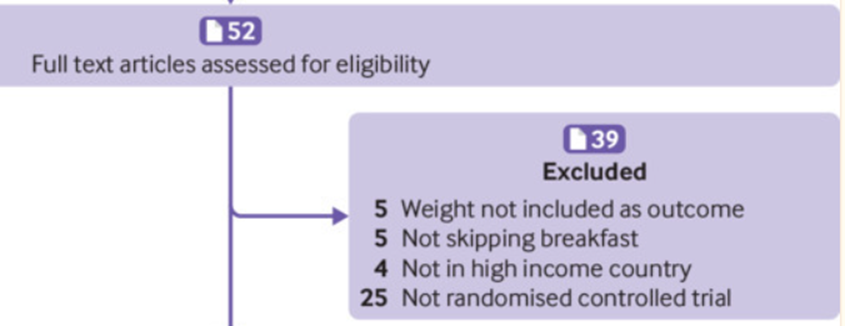
(1) Sievert et al. evaluated 52 studies, most of which were rejected because they did not meet the conditions for good scientific research or were not properly randomised.
(2) The studies included by Sievert et al. varied greatly in duration (from one day to 6 weeks) and quality.
(3) The conclusion of Sievert et al. is that there is no evidence for a negative effect of skipping breakfast. What is more, the results point in the opposite direction: skipping breakfast could be a useful strategy for losing weight.
Here is what I have to say about these remarks:
(1) That a large part of the 52 studies found were excluded because they did not meet the conditions for good scientific research is not true. The studies dropped out because they did not meet the inclusion criteria. Sievert et al. are also transparent about the reason for the exclusion: studies dropped out because they did not have weight as an outcome, breakfast was not skipped, the study was not carried out in wealthy countries or the study was not a randomised controlled trial. Spector says it was due to the quality of the research, but quality is not a criterion on which you may exclude studies. That would cause selection bias in which only studies of good quality are included. The quality of studies (the test of criticism) is only assessed later in a review, after the selection has been made. The quality of the studies is then taken into account in the conclusion, discussion and meta-analysis. I cannot imagine that someone with so much experience in science does not know this….
(2) It is true that there was variation in duration (from one day to 6 weeks) and quality in the studies, but it is not quite right. This variation was in the studies that looked at daily energy intake. The studies that looked at weight ranged from two to 16 weeks. This is quite logical: to estimate someone's energy intake you need less time than when you look at weight. What someone's weight does is the result of someone's daily energy intake over a longer time. So for weight you need more time to see the effects.
“As the quality of the included studies was mostly low, the findings should be interpreted with caution.” – Sievert et al.
(3) It is true that Sievert et al. conclude that skipping breakfast can actually be a useful strategy. Though they are a bit more careful by concluding that eating breakfast is not a good strategy for losing weight. However, Sievert et al. do add the caveat that the quality of the studies is low and that the conclusion should therefore be treated with caution. Although Spector does state that the quality of the studies is low, he does adopt the conclusion without caution. The quality of the studies is so low because of problems with blinding, randomisation and selective reporting. For example, participants in the RCTs know perfectly well whether they are in the breakfast or the no-breakfast group (blinding). They also know that their weight and diet are being looked at. I always wonder what that does to someone: do you make different choices? (performance bias) It is also unclear for most of the studies which randomisation process was used to place people in a group at random. (selection bias) Finally, it is also unclear which outcomes were in the plan of approach to be reported and whether all of these were reported in the final study. (reporting bias)
Observational vs experimental
Despite the low quality of the randomised controlled trials, this study is, according to Spector, the evidence that everyone has been misled by the observational research that has shown over recent decades that skipping breakfast increases the chance of overweight. Skipping breakfast would never have been the cause, but an accompanying characteristic of people who also have a lower income and level of education, and more often have poor health and a poor diet, so Spector reasons. In addition, people with overweight would skip breakfast more often for various reasons. Sievert et al. name the same as an explanation for the difference in results between observational and experimental research. The Voedingscentrum also named this as a caveat.
“Like the rest of the population, nutrition experts, doctors and professionals from the food industry have been misled by headlines about a number of observational studies. In those population studies it had turned out that people who skipped breakfast were more often overweight. The skipped breakfast was not the cause here, however, but more of an accompanying factor that distorted the picture. People who skipped breakfast had, on average, a lower income, a lower level of education, poorer health and a poorer diet than the participants who did eat breakfast. These social factors are each associated with overweight, and the association found therefore has nothing to do with skipping breakfast. Research indicates that people with overweight are also more likely to try to follow a slimming diet. After a binge they perhaps more often feel guilty and then skip a meal. (no source)” (translated from Dutch)
In any case it is clear that this study cannot be put forward as evidence for the importance of eating breakfast to prevent overweight. Still, the BDA (association of dietitians in England) does so. Very strange.
Eating breakfast and concentration/cognitive function in children
Almost every health organisation I have named makes a claim about improved concentration and cognitive function in children who eat breakfast. Spector makes the same case for the relationship between eating breakfast and better concentration and cognitive function in children as for weight: it is based on misleading observational research.
Here too Spector cites a systematic review and meta-analysis of RCTs, about which he has various remarks/comments.
Adolphus et al. carried out a systematic review and meta-analysis of RCTs to investigate the effect of eating breakfast on cognitive performance (memory, attention, decision making, psychomotor function and language) in children and adolescents.
In short, Adolphus found the following:
34 studies investigated the acute effect of a breakfast on cognitive performance within 4 hours of the breakfast. The studies are divided into breakfast compared with no breakfast and breakfast compared with another kind of breakfast. In addition, 11 studies looked at the effect of eating breakfast daily through school breakfast programmes. Eating breakfast seems to have a favourable effect on cognitive function within 4 hours of the breakfast. This effect would be stronger in undernourished children. Furthermore, the results are very inconsistent because of low quality and differences in the design of the studies.
The authors conclude that no strong conclusions can be drawn from this review and meta-analysis. It seems that eating breakfast compared with no breakfast has an acute positive effect on cognition, but this is mainly in undernourished children. Too little research has been done on adolescents, on natural settings, and there is too much research with groups that are too small and with cognitive tests that were not made to measure the effect of a nutrition intervention on cognition.
If we then look at the remarks Spector makes about the study by Adolphus et al., you can summarise them as follows:
(1) The studies in the review are of remarkably poor quality.
(2) Of the 21 studies that looked at the acute effect of eating breakfast, only 8 showed a positive effect.
(3) In all the other studies with effects, this was only in undernourished boys.
(4) In all studies the research was done in an artificial scenario that is difficult to translate to the real world.
Here is what I have to say about these remarks:
Spector's interpretation is a bit too much of a shortcut. It is true that in 8 of the 21 studies focused on attention a positive effect was found. In total 13 studies found a positive effect (but 5 studies found effects only in subgroups). However, attention was not the only outcome.. 8 of the 15 studies focused on memory found a positive effect (in well-nourished children), 6 of the 13 studies focused on decision making found a positive effect (in well-nourished children) and 2 of the 4 studies focused on psychomotor function found a positive effect and 2 of the 4 studies focused on language found a positive effect (but only in undernourished children). As Adolphus already said: inconsistent results, but certainly with a tendency towards a positive effect.
I have nothing further to remark on Spector's criticism. There are very many problems with the (quality of the) studies, such as not reporting compliance (for example, you cannot be sure whether children in the 'no breakfast' group really had no breakfast), cognitive tests that were not made to measure subtle differences after nutrition interventions, little consistency in results and cognitive tests that cannot be translated to the real world.
Effect of eating breakfast on weight, health, concentration and cognitive function
All in all there are glaring flaws in the experimental research on the effects of skipping breakfast. RCTs actually show the opposite of the results from observational research when it comes to weight, but health organisations still keep advising against skipping breakfast—and all of this because of the influence of the food industry on science and government officials, according to Spector.
“Despite all those glaring flaws in the research and despite the steady increase in opposing findings from RCTs, the idea that skipping meals is unhealthy has prevailed for decades. It is still one of the eight main tips for a healthy diet in the recommendations of the public health authority Public health England, the current dietary guidelines of America and Australia… As a result of the influence of the food industry on government officials, these incorrect claims have been included in government-approved health advice.” (translated from Dutch)
Unfortunately the Voedingscentrum did not want to respond on the substance to my email with questions about their position (and those of other organisations).
Conclusion
Okay, let me summarise it all and share what I think of Spector and his attack on breakfast. Firstly, I share Spector's astonishment at the lack of a single definition of breakfast. Even though so many health organisations are firm about the health effects of breakfast, almost none of these same organisations cite a clear definition of what breakfast is. How can you advise people about something if you do not clearly say what that something actually is.
Secondly, according to Spector the experimental research (which he cites) would show that everything that has been shown by observational research is not true. The observational research itself would be bad and misleading. But he makes these claims constantly without support. All he says is that there are confounding factors that explain the causal link between skipping breakfast and disease, weight and cognition. I do have problems with this. He shows, after all, that the experimental research that has been done is of poor quality: a lot of difference in design and high chances of bias. How can you then take that same literature to say: 'Yes, see! The observational research is wrong.' You cannot both say that the experimental research is rubbish and say that it proves the opposite of observational research. Observational research certainly has its place in the body of evidence.
The Voedingscentrum takes more or less the same point as Spector: it is not yet clear whether the association is a causal link. The problem, though, is that Spector does not go into all the observational research that exists – and that is a very great deal. For example, the AHA has written an official position on meal timing and frequency in which they give an overview of the current literature. Briefly summarised: there is a great deal of evidence for the positive effects of eating breakfast and eating regularly on our health. In addition, there are certainly scientific definitions of breakfast, a definition that is widely used: “the first meal of the day eaten before or at the start of daily activities within 2 hours of waking, typically no later than 10 am, and consisting of a calorie level of 20% to 35% of total daily energy needs.”
Spector acts as if experimental research is absolute: “it is at the top of the Pyramid of Evidence so those results always lead.” But that is not how it works in nutrition science. Experimental research is sometimes very difficult (as you can see in the poor quality) and the full body of evidence must always be looked at. That Spector does not do this disappoints me as a nutrition scientist.
I am a bit torn about Spector's position. It is true that there are contradictions between the results of observational and experimental research. Experimental research ranks higher in the pyramid and therefore has the power to undermine the results of observational research. However, as Spector himself says, the quality of the experimental research is low and there is a lot of inconsistency in the results.
Benefits of skipping breakfast
Besides being critical, Spector also cites scientific research that does support the benefit of not eating breakfast. He makes two claims and I have taken a short dive into the support for them.
Claim: “There is more and more scientific evidence for the idea that shortening the time we spend eating and extending our fasting period to longer than twelve to fourteen hours can lead to a lower insulin level and can help some people lose weight.”
Gabel et al. carried out a kind of randomised controlled trial to investigate the effect of an intermittent fasting protocol (16 hours of fasting and 8 hours of eating/drinking) on weight and metabolic risk factors for cardiovascular disease in people with obesity. Participants could eat as much as they wanted between 10 and 18 o'clock, after which only water could be drunk. The outcomes were compared with a control group (no intervention), which comes from another study a few years earlier.
In short, Gabel et al. found the following:
Both energy intake (-341 kcal/day) and weight (-3 kg) went down significantly compared with the control group. Almost all metabolic factors stayed the same except blood pressure, which also went down a little, significantly, compared with the control group.
Gabel et al. conclude that intermittent fasting leads to a small energy deficit and weight loss without counting calories.
If we then look at Spector's claim, I do have some remarks. In the claim he refers back to the previous myth that Spector dealt with, which I wrote about in 'Nutrition guidelines apply to everyone’. There he already claimed that insulin is a cause of overweight, but he cited little strong evidence for it. Now he makes it look as if intermittent fasting lowers insulin and thereby helps with weight loss. However, if we look at the study by Gabel et al., insulin is not significantly lowered at all compared with the control group. Gabel et al. themselves explain that the intermittent fasting protocol helped lower energy intake and thereby led to weight loss. This had nothing directly to do with the fasting. As far as I am concerned, Spector's interpretation is misleading.
In addition, I somewhat doubt whether eating your first meal at 10 o'clock is not simply having breakfast. Spector cites this study as evidence against breakfast, but I would call a first meal of the day at 10 o'clock in the morning breakfast. Sure, the definition of breakfast (as we read earlier) is not always equally clear. Still, I think it is a big leap to then use this study as evidence against breakfast.
Claim: “Research on the microbiome is still at an early stage , but there are findings that show that long periods without food are not good for our microbiome, but that it possibly does benefit from short periods of fasting, for example by skipping breakfast. After a period of four to six hours without food, some species start to divide and feed on carbohydrates in the mucus layer of the intestinal wall, so that they clean the intestinal wall and make the gut barrier more efficient and healthier.”
This concerns a very interesting narrative review on the synergy between eating patterns (timing), our biological clock and the gut microbiome. As Spector says, this is still in its infancy: no studies have been done with humans. Only with mice. This is a good start and the review is certainly interesting to read, but the strength of the evidence is low and therefore I will set it aside for now.
“To the best of the authors’ knowledge, there are no published studies on the effect of Time-restricted Feeding (TRF) on the human GI microbiota. Given the preclinical findings related to relationships between the microbiota and TRF, it is probable that TRF interventions in humans would impact the microbiota; however, additional TRF research is needed to make a determination.”
Early-Time Restricted Eating
Spector comes with little evidence for the benefits of not eating breakfast. His biggest argument is the benefits of extending the daily fasting period. According to him it can therefore do no harm to skip breakfast, although fortunately he also adds the caveat that whether eating breakfast works for you or not depends on the person. Still, I am left with the question: why breakfast? Why not extend the fasting period by not eating anything in the evening instead? Is Spector not familiar at all with the phenomenon: Early- time restricted eating? (also called time-restricted feeding or intermittent fasting).
Early-restricted eating is an intermittent fasting protocol in which you eat as early as possible. The idea behind it is that this fits our biological clock better and thereby (independently of weight loss) has positive effects on our health.
The first study to test this in humans is the study by Sutton et al. in (2018). They found that an early-restricted eating protocol (from 8 o'clock in the morning to 14 o'clock in the afternoon) led after 5 weeks to several positive metabolic effects compared with a control group that followed a standard protocol (eating over the whole day), independently of weight loss. Both groups had their meals provided, weighed out according to energy expenditure. Participants had to weigh themselves daily, because if they lost weight they were given more to eat. The study was still very small (8 participants) and had no control group with late-restricted eating (starting to eat at 12 o'clock or later). So you cannot yet say on this basis that early is better than late.
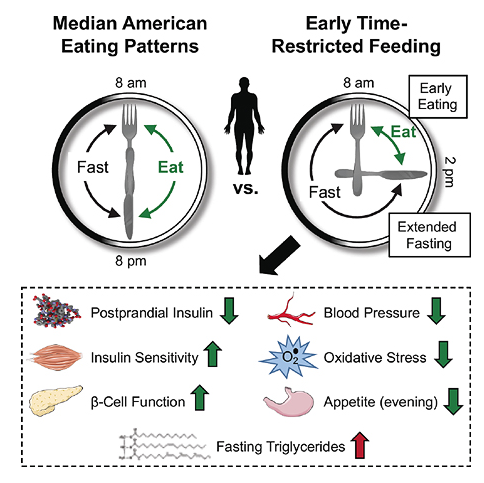
The second study is by Hutchison et al. (2019). This study compared early-restricted eating (8 o'clock to 17h) with late-restricted eating (12 o'clock to 21 o'clock). However, the design is different from that of Sutton et al. Here it was only 1 week in which participants followed a protocol, after which the effect of a meal on blood values was compared. Also, the early group still had dinner a lot later than in Sutton et al. The group was somewhat larger (15 participants). Early showed a lowering of blood sugar level, and both early and late showed that blood sugar level responded better to a meal after following the protocol for 7 days. However, the study did not show the positive effects that Sutton et al. did show. Even though both groups did show weight loss in this study.
The third study is by Jamshed et al. (2019). This study is more similar to Sutton et al., with roughly the same fasting protocols used: early between 8 and 14h and control group between 8h and 20h. However, this was only 4 days and 11 participants. Besides various blood values, the scientists also looked at genes related to our biological clock, autophagy and oxidative stress. Even though there was no weight loss, the early-TF showed positive effects compared with the control group. Blood sugar level went down and several healthy genes were activated more.
The fourth study is by Jones et al. (2020). They showed that when you have 16 healthy young men follow either an energy deficit protocol or an early-restricted eating protocol (8 hours and 16 hours) for two weeks, the early group showed more positive effects such as insulin sensitivity and better glucose and protein uptake by muscles. Both groups lost weight.
The most fifth study is by Nakamura et al. (2021). They showed that merely an early dinner (18h) compared with a late dinner (21h) in twelve young participants led to better blood sugar levels and blood fat levels in the morning after breakfast (8 o'clock). Without weight loss.
The most recent study is by Xie et al. (2022). They had three groups follow a protocol for 5 weeks: early-IF (8-15), late-IF (11-20) and control (eating all day). In total there were 90 participants (30 per group). Participants could eat as much as they wanted. The results showed that only the Early-IF group ate fewer kcal, lost more weight, and had better insulin sensitivity, lower fasting glucose, less inflammation and better gut flora diversity compared with the control group (so no IF).
Despite the popularity of intermittent fasting and the various variants (early and late), the research is still in its infancy. There is a lot of difference between the studies, which often include small groups of participants: healthy or with disease (diabetes or metabolic syndrome), different IF protocols and different outcome measures. Larger studies are on their way that want to test the hypothesis of whether early is better than late in a rigorous way. In other words, breakfast yes or no. I wait with great interest to see what these studies will show. Until then, do not let anyone tell you that skipping breakfast does no harm, that is still far from certain.
What did you think? Let me know in the form of a comment or an email: [email protected]
Did you come across a claim on the internet or social media and are you curious about an assessment of its support, let me know and I will dive in!
Do you want to support me and my nutrition science adventure? Share my articles or the podcast on your socials!
Everything you read on this website is my opinion based on knowledge and experience. There is a good chance that I sometimes overlook something, or that something could be better. I would love to hear it! We do science together.
Volg me op: