
21 min read
Ingelepeld: why only little (not?) of what we have been told about nutrition is right (Myth 1)
Almost everything we have been told about nutrition is wrong. Bad science, wrong interpretations of scientific literature and the influence of the food industry have meant that from childhood on we have been spoon-fed wrong information about nutrition and health, according to professor of genetics Tim Spector in his book Ingelepeld. According to him, the idea that dietary guidelines and diet plans apply to everyone is a myth: it is personal. We simply differ too much from each other, so general dietary guidelines based on averages are not adequate. But what makes us so different, then? Does Spector show how you are supposed to interpret scientific literature? How strong is the evidence that Spector provides in his book?

At the beginning of 2022 I came across a book review of Ingelepeld on VoedingNu. The writer of the review, a dietitian in training, was raving about the book because “the arguments Spector presents are so convincing that it creates urgency for change.” This, together with the fact that Tim spector, the author of the book, is professor of genetics (with a focus on both nutrition science and the microbiome) at the prestigious King’s College London, made me curious about the support for his arguments. In this series of articles I will take a dive into the myths that Spector refutes one by one in his book with scientific evidence.
The introduction
When I read the introduction of Ingelepeld I sometimes thought ‘I could have written this introduction’ and sometimes I thought ‘what nonsense’. According to Spector, decades of bad science, wrong interpretations of scientific literature and influence from the food industry have caused an incredible amount of misleading and sometimes even dangerous information about nutrition and health to be spread. This makes nutrition science unique, says Spector, and on this I completely agree with him. However, Spector and I differ in our thinking about where the misleading information comes from. For example, according to him the government guidelines can be an unreliable source of information, because, so he reasons, if the advice worked we would long since have been healthier, slimmer and free of nutrition-related conditions.
“I was astonished to find out how much of what we are told about nutrition is, at best, misleading, and at worst simply wrong and even dangerous for our health. In this book we will see that it makes no difference whether that advice comes from dietitians, doctors, government guidelines, scientific publications, or anecdotes we hear from friends or family; all those sources of information can be unreliable.” (translated from Dutch)
Sidenote (December 2022): I have meanwhile come to agree more and more with Spector. Really, all those sources of information can be unreliable.
Nothing could be further from the truth, according to Spector, by which he suggests that the advice is actually followed by the population. He even makes it seem as if we have become unhealthy on a massive scale precisely because we follow the general nutrition advice. No source, no evidence. How dare you make such claims without evidence? Especially when your book is full of criticism of nutrition science and scientists. I could now throw around lots of literature that shows that the vast majority of the population does not follow the dietary guidelines. Which shows that Spector's reasoning doesn't make any sense. However, what is asserted without evidence can be dismissed without evidence (and no, a correlation between the existence of the guidelines and a rise in diseases of affluence is not evidence).
My own bias
As may already have been clear, I am positive about the guidelines of bodies such as the Gezondheidsraad and the Voedingscentrum. When I look at the guidelines, I do see well-considered guidelines that take into account not only health but also current intake, sustainability and practice. Without heavy restrictions or extremes. I am convinced that these bodies also know that they give advice at population level and that at the individual level there can be differences. There is always still a responsibility on people themselves to take care of their health and to follow the advice of their healthcare provider when there are nutrition-related health complaints. However, I am convinced that if more people ate according to the guidelines Goede Voeding 2015, we would be a lot healthier together.
Spector is convinced that the dietary guidelines from government bodies are not adequate for the health of the individual, because nutrition is personal. This is of course no surprise for someone who specialises in genetics and the microbiome: both are very person-specific factors. The first myth that he refutes in his book is therefore the validity of general dietary guidelines and diet plans. Are we different enough to throw the dietary guidelines in the bin?
Myth 1: ‘dietary guidelines and diet plans apply to everyone.’
Spector reasons that both the labels on our food and general dietary guidelines and diet plans are not adequate for our individual health. He bases this on two arguments: (1) everybody's body processes carbohydrates and fats differently (which you see back in blood values); (2) everybody's body responds differently to eating patterns low or high in carbohydrates and fats (which you see back in weight during weight loss).
Spector makes one more small remark at the start of the chapter: people who follow alternative routes of diet and wellness gurus and have chosen gluten-free, ketogenic, low-carbohydrate, paleo or intermittent fasting also run into this problem.
Everybody's body processes carbohydrates and fats differently
The PREDICT study is a collaboration between King’s College London (the team around Spector), Massachussetts General Hospital, Stanford University and ZOE. ZOE is a company that deals with precision nutrition. The method of this study is the same as when you would buy and download the app ‘ZOE’: the app determines, on the basis of your metabolic responses, what you should or should not eat for good health.
Berry et al. carried out a large randomised controlled trial (RCT) with around 1,000 healthy people. The aim of the study was to examine the effect of meals with different macronutrient (carbohydrates, fats and protein) ratios on postprandial (after the meal) blood levels of fats, carbohydrates and insulin (metabolic responses). In addition, the researchers looked at which predictive factors influenced the effect.
In short, Berry et al. found the following:
There were very large differences between people in postprandial metabolic responses to carbohydrates, fats and insulin. This is based on the coefficient of variation, a measure of the spread around the mean. The largest differences were in metabolic responses to fats (103%), followed by glucose (68%) and insulin (59%). Important predictive factors for metabolic responses to fats were the microbiome (7.1%) and the macronutrient ratio of the meal (3.6%), but this did not hold for carbohydrates (6% microbiome and 15.4% macronutrient ratio). People's genes were a relatively weak predictive factor (9.5% for carbohydrates, 0.8% for fats and 0.2% for insulin).
Berry et al. conclude that this study confirms large differences between people in metabolic responses to carbohydrates, fats and insulin. This is mainly due to factors we can influence, such as the microbiome, the macronutrient ratio of our food and other lifestyle-related factors. People respond in the same way to different meals with the same macronutrient ratio, but there was a very low correlation between responses to fat and carbohydrates. In other words, people usually respond badly either to carbohydrates or to fats, usually not to both. These findings show that there is a need for specific nutrition advice instead of general guidelines. Especially from a cardiovascular health perspective.
If we then zoom in on the claim: ‘studies show that different kinds of food with a comparable nutritional value can still have very different effects on health.’
Then Spector makes a very strong point. I really get very enthusiastic about such a nice RCT as the PREDICT study. Many participants and a strong design mean that the study provides strong evidence for the hypothesis that every person is unique and therefore has a unique metabolic response to food.
If we dive deeper into the results of the study, there are important caveats that I want to explain.
Firstly, the healthy people who took part in the study are not that healthy at all. The authors state that healthy stands for ‘free of disease’, and that says it all. If we look at Table 1 (the table with the description of the participants at the starting point of the study) we see that the participants are far from optimal health. For example, the mean BMI is 25.5, which means that around 50% of the participants have a BMI that is too high (25 or higher is unhealthy). BMI of course doesn't say everything, but the table also shows that about 25% of the participants have a waist circumference of 93.5 cm. The guideline for a healthy waist circumference is 80cm for women and 94 cm for men. Unfortunately the study made no distinction between women and men, so the 93.5cm mean is for both. The chance is high that more than 25% of the participants have a waist circumference that is too large, and waist circumference is a good measure of how much belly fat (the most unhealthy fat) someone has. In addition, around 50% of the participants have a cholesterol level that is too high and 25% an HBA1c value (HBA1c is a measure of the average glucose levels in the blood over the past months) of a pre-diabetic. Since these are all lifestyle-related factors, and lifestyle-related factors turn out to have an influence on our metabolic responses in this study, this should be taken into account in the conclusion. I will come back to this later.
Secondly, people are served an ultra-processed (unhealthy) meal: a muffin. Sometimes they get this together with a milkshake and a fibre bar to change the macronutrient ratios of the meal.
“Following the baseline blood draw, participants consumed a breakfast (muffins and milkshake at 0 min) and lunch (muffins at 240 min) test meal (Supplemental Table 2), each to be consumed within 10 minutes. Additional venous blood was collected via cannula at 15, 30, 60, 120, 180, 240, 270, 300 and 360 minutes.”
I fully understand the choice for the muffin: you can process the muffin into the ratio of carbohydrate, fats and protein that you want. However, in the introduction of the book Spector is precisely critical of science that focuses only on the main components of food.
“Part of the problem is that nutrition science is based on a centuries-old misunderstanding, in which our food was divided into no more than three main components: carbohydrates, proteins and fats…. All foods consist of a complicated mixture of carbohydrates, fats and proteins. If science itself is already dangerously simplified and misleading, it only increases the chance that those messages will be twisted if we simplify the results of that science even further by converting them into rules and guidelines.” (translated from Dutch)
Spector also indicated earlier that food consists of thousands of substances and I agree with him that we precisely want to move away from a reductionist perspective. The focus must be on the whole food matrix. Yet in this study they choose to do research with an ultra-processed product that consists mainly of white flour and sugar (this is also the product that ZOE sends you at home). Since this study is used by Spector to refute the validity of the dietary guidelines, it is important to point out that worldwide not a single dietary guideline recommends consuming ultra-processed food. It is beyond dispute that heavily processed food is unhealthy.
Thirdly, a large part of the participants, despite the large differences, have healthy metabolic responses to the macronutrients. Spector makes the assumption in his book that “regular peaks in the blood levels of glucose, fats and insulin cause metabolic stress and in the longer term are linked to weight gain, disease and a reduced or, on the contrary, increased appetite.” He gives no reference for this and therefore no support. After that he makes the assumption that “if peaks occur regularly in your blood sugar, insulin or triglycerides (fat) in the blood, in the longer term that is a stress factor for your system, which makes your body store more energy in fat cells.” Here he does give a source (source 6).
Source 6 is a study that focuses on the relationship between insulin secretion (insulin level in the blood 30 minutes after a glucose intake) and BMI. Various databases were used in which the genetic factors that influence insulin secretion or BMI were included, so that people can be divided into groups on the basis of their genes. Also called a Mendelian randomisation analysis. The results of the study show that people with a gene for a stronger insulin response had a higher chance of a higher BMI. The other way around there was no association. The authors conclude that a lifelong higher insulin secretion (due to a gene variation) increases the chance of overweight. Someone in the lowest 16% of insulin level weighed on average about 2.5 to 3.1 kg less than someone in the highest 16% of insulin level. Whether this is clinically relevant I will leave open for now.
“It appears that a lifetime of high glucose-stimulated insulin secretion, likely in conjunction with typical diets consumed by the individuals in these cohorts, is obesogenic. An increase in log insulin-30 by one standard deviation (SD) was associated with 0.1 SD increase in covariate-adjusted BMI. This effect size roughly translates to a 160–180 cm person with below average insulin secretion (−1 SD) weighing 2.5–3.1 kg less than the same person with above average insulin secretion (+1 SD).”
According to Spector, this source shows that regular peaks in blood sugar, insulin and blood fat cause more fat storage. Besides the fact that blood levels of carbohydrates and fats were not included in this source, this study only shows an effect on BMI. Not on fat storage. BMI and fat storage are not 1 to 1 identical. The authors of the study speak of weight, but weight is much more than fat. It therefore feels misleading of Spector to suggest that it is purely about fat storage, while the study he cites for this never measured this directly. Feels a bit like nit-picking, but well, Spector himself indicated that misleading information about nutrition and health is the result of bad interpretations of scientific literature. In addition, this study is about people who have had a higher insulin all their lives because of their genes. You cannot compare this 1 to 1 with people without those genes.
What about the effect of peaks in glucose and fats in the blood on our health, then? Spector gives no support for this. I dived into the PREDICT study and there they do give support.
“Postprandial lipid, glucose and insulin dyshomeostasis are independent risk factors for NCDs and obesity7,8,9”
Source 8 is the same study that Spector cites about insulin and BMI. Source 7 is a publication by an expert panel of scientists and doctors about the effect of fats in our blood and our health. According to the experts, a fat concentration <2.5 mmol/L at any time after eating a meal is desirable.
“TG concentration ≤ 2.5 mmol/l (220 mg/dl) at any time after a FTT meal should be considered as a desirable postprandial TG response.”
Source 9 is a narrative review about the relationship between postprandial blood glucose peaks and our health. This publication shows that the relationship between blood sugar level and weight is not nearly as strong as Spector claims. There is, however, a strong association with cardiovascular disease, where people with higher peaks (8.3 mmol/L – 10.7 mmol/L) have a 27% higher chance of cardiovascular disease compared with people with lower peaks (3.8 mmol/L – 5.9 mmol/L).
“Some studies suggest that diets comprising foods that elicit a lower postprandial glucose response may be useful as part of an overall strategy for combating obesity, but the evidence for a role of postprandial glucose per se in these effects is considerably weaker… there is no strong mechanistic basis for normal variation in postprandial blood glucose per se (i.e. differences in blood glucose seen between typical high- vs. LGI treatments) to affect appetite and ultimately body weight… The cardiovascular risk appears similar for fasting and post-challenge blood glucose levels, with 27% greater risk in individuals with the highest post-challenge blood glucose levels (150 (8,3 mmol/L)–194(10,7 mmol/L)mg dL) vs. those with the lowest ones (69 (3.8 mmol/L)–107(5.9 mmol/L) mg dL).”
From these studies it turns out that it is not necessarily about getting peaks in the blood, but about how high the peaks are. Ranges are given here, within which people can therefore differ without necessarily having increased risks of health problems. If we then look at the participants of the PREDICT study and their metabolic responses to the muffin as breakfast and lunch we see the following:
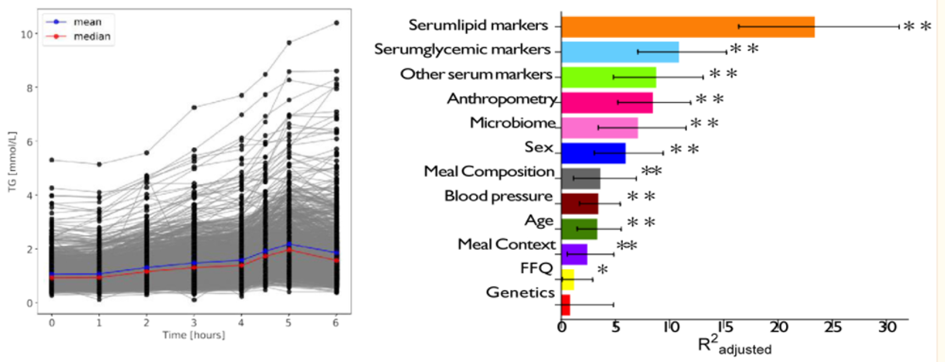
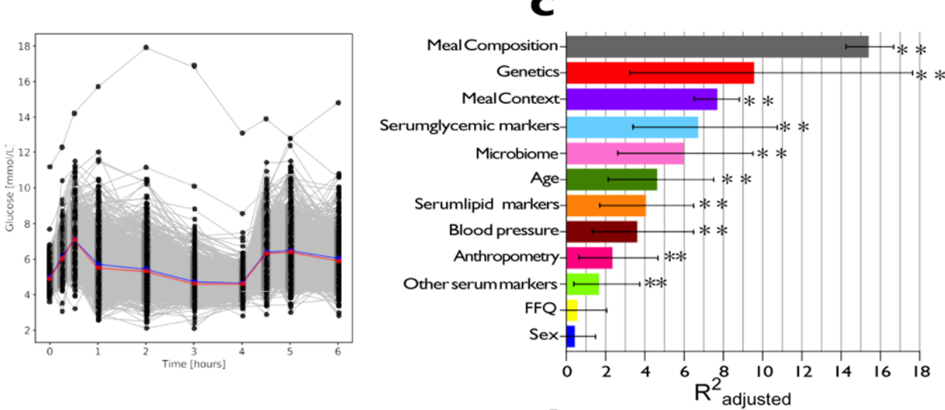
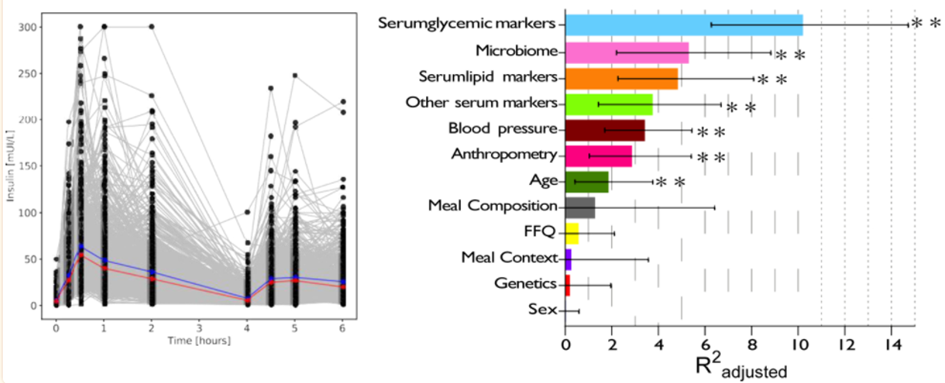
From the graphs it turns out that, as the study states, there is a large spread in metabolic responses. However, many participants score within the mentioned healthy norms on all three outcomes (glucose: <5.9, TG: <2.5 and insulin <270). It seems that people score least well on glucose, where both the mean and most of the dots do come above 5.9. Which brings me to the last point.
Finally, the factors that make us different in metabolic responses to carbohydrates, fats and insulin are mainly lifestyle-related factors. The height of the peaks is therefore not determined by who someone is but by what someone does. As Spector himself indicates, the differences between people are mainly determined by factors that we have under our own control. These are lifestyle-related factors such as fasting blood values, meal composition and timing, sleep rhythm, body composition and microbiome.
“The lack of a major genetic component to these traits highlights the likely involvement of modifiable environment exposures. Indeed, we found that meal composition and context (e.g. meal timing, exercise, sleep and circadian rhythm) were core determinants of postprandial metabolism.”
Spector interprets this as ‘general dietary guidelines do not hold for individuals’, but I interpret this as ‘unhealthy people respond more unhealthily to (unhealthy) food’. If people would stick more to the guidelines (and so not only the guidelines for nutrition but also for other lifestyle-related factors), they would become healthier and the body will therefore respond in a healthier way to food. A negative spiral that you can turn around into a positive spiral. But as I said, it is just how you interpret it – and this is determined by your current beliefs. Since Spector is an adviser at ZOE, I assume that his belief is that people are so different that precision nutrition is always needed. In any case it is clear that carbohydrates are the only nutrient where genes play an important role. You see this back in the differences between people and the higher unhealthy peaks in the graph. But as I indicated earlier, you are dealing here with relatively unhealthy people (some of them are prediabetic) who are served an unhealthy meal. Which for me explains a large part of the variation.
The conclusion
The PREDICT study is a really cool, well-designed study that shows how complex the interweaving of lifestyle and our health is. People are unique and so is our metabolic response to food, but the differences between people lie mainly in lifestyle-related factors. According to Spector the study shows that different kinds of food with a comparable nutritional value can still have very different effects on health. But I see it the other way around: the differences in our health cause us to respond differently to food with a comparable nutritional value. This means that the more unhealthily you live, the worse your body can deal with (unhealthy) food. But also the healthier you live, the better your body can deal with (unhealthy) food.
A nice example of this is a review that Gemma Evans, a former British TV journalist, posted on her Youtube channel Healthhackers. She bought the ZOE app and started working on her diet (definitely worth a look!). ZOE advised her to eat fruit such as apples and kiwis even though this fruit gave her high blood glucose peaks. When Gemma went to ask ZOE about this she got the following answer:
(16:40)“We do believe blood sugar is very important to your health, but it is important to note that it’s only one of the factors that contribute to your scores (and overall health)… some foods might trigger a blood sugar response in the short-term, but in the long-term, they are also nourishing the good bugs in the gut. Supporting a healthier, more diverse gut microbiome, over the longer term, is likely to have a positive impact on blood sugar control.”
In other words, when you start living healthier, your body will respond to food more healthily by itself. The two-part review is a nice look into the ZOE app and their mission to make precision nutrition accessible to everyone.
It is a pity to see that Spector has so much criticism of science and the interpretation of it. Especially when he himself is casual about supporting his claims. For example, he gave hardly any support for the harm of the peaks in blood levels to our health. He makes it seem as if peaks in the blood are always bad, but this turns out to be more nuanced after all. In addition, the studies did not always turn out to tell the same story as he claims. Also, by his own standard, because of the focus on the main components, the PREDICT study is not good science, yet he uses it as evidence to support his claims.
Everybody's body responds differently to eating patterns low or high in carbohydrates and fats
Both in his book and in the PREDICT study reference is made to the DIETFITS study. This study is said to show that there are large differences in weight loss between people when they lose weight with an eating pattern high or low in carbohydrates and fats.
“People differ greatly in their responses to diet interventions. The DIETFITS study, for example, randomised 609 people to either a healthy low fat or a healthy low carbohydrate diet for 12-months34. By study end, average weight loss was similar between groups (~5–6kg), but wide variations were seen within groups (−30kg to +10kg).”
Gardner et al. carried out a randomised controlled trial to investigate what the effect on weight is when people follow a healthy eating pattern low in fat compared with a healthy eating pattern low in carbohydrates for 12 months. In addition, the researchers looked at whether genes and insulin secretion were predictive factors for the effect of the eating patterns on weight.
In short, Gardner et al. found the following:
Of the 609 participants, 40% had a low-fat gene and 30% a low-carbohydrate gene (these gene variations have been associated in earlier studies with people's metabolic responses to fats or carbohydrates). 481 (79%) of the people reached the end of the study. The macro ratio of the low-fat group and the low-carbohydrate group was 48% vs 30% carbohydrates, 29% vs 45% fat and 21 vs 23% protein. After twelve months the low-fat group lost on average 5.3 kg and the low-carbohydrate group lost on average 6 kg. There was no significant difference between the groups. Neither genes nor insulin secretion had a significant effect on weight loss.
Gardner et al. conclude that after following a diet for 12 months there was no significant difference in weight loss between an eating pattern low in fat or low in carbohydrates. Neither genes nor insulin secretion were associated with the weight loss. This means that neither an eating pattern low in fat nor one low in carbohydrates is to be preferred during weight loss.
If we then zoom in on the claim: ‘This research therefore clearly shows that if you want to know which foods work best (for weight loss) for your metabolism, you have to know your own personal nutritional response – and that cannot be predicted with the help of simple genetic tests that you can order online.’
Then it is clear that Spector does not base his claim on the results of the study, at least not the results that Gardner et al. note in the abstract. He is referring to the spread around the mean within the groups. He is then referring to the following figure:
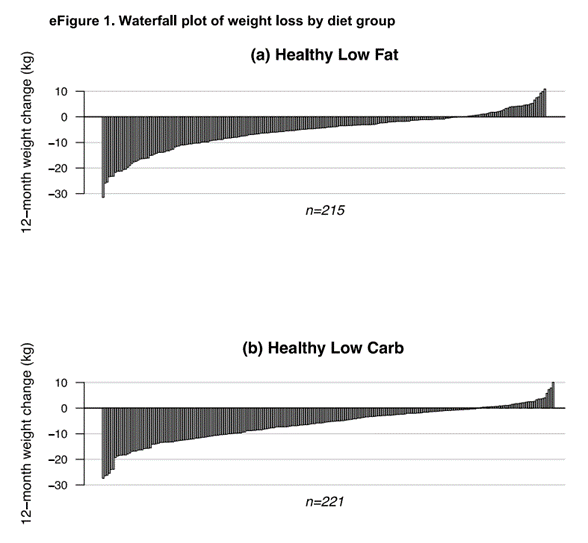
From this figure it turns out that in both groups there was a spread of roughly between losing 30 kg and gaining 10kg. The figure also shows that not everyone lost weight after 12 months, but that the vast majority of people in both groups did lose weight. Can you, on the basis of this spread, then say that this study clearly shows that knowing your own metabolic response to macronutrients is necessary to know which eating pattern you should keep to in order to lose weight? No, not without a few substantial caveats, because if we dive deeper into the results of the study I have two findings that I want to share with you.
Firstly, the variation in weight loss can just as well be explained by the energy intake of the participants. The participants were not given an energy restriction and were allowed to decide themselves how much fat, carbohydrates and kilocalories (kcal) was comfortable for them to eat. In addition, they received three clear instructions: (1) eat as many vegetables as possible; (2) eat as little added sugar, refined flour and trans fats as possible; (3) focus on unprocessed products, high in nutrients and prepared at home as much as possible.
“Then individuals slowly added fats or carbohydrates back to their diets in increments of 5 to 15 g/d per week until they reached the lowest level of intake they believed could be maintained indefinitely. No explicit instructions for energy (kilocalories) restriction were given. Both diet groups were instructed to (1) maximize vegetable intake; (2) minimize intake of added sugars, refined flours, and trans fats; and (3) focus on whole foods that were minimally processed, nutrient dense, and prepared at home whenever possible.”
Even though no energy restriction was imposed, the participants in both groups ate on average 500 to 600 kcal less than at baseline (starting point). Which shows that people do not necessarily have to focus on kcal to lose weight, as long as the focus is on eating healthily. However, it does mean that there is spread in how many kcal the participants ate. In addition you also see that both the average amount of kcal consumed and the average weight go up after the first 3 months. This explains why the average weight after 12 months was also higher in both groups than after 6 months: people simply started eating more (energy) again. Then you can ask yourself the question: what explains the spread in weight between the participants? Is it a difference in metabolic responses? In any case insulin secretion was not associated with weight. Genes also turned out to play no role. Is the energy balance of participants then not a much more obvious explanation? There was namely also a spread in energy intake. In addition, there was no restriction on energy intake (and lowering energy intake in the long term is very hard for very many people), participants could have eaten much more or less than they reported and they could have started to move less (which often happens with people who diet). All of this together can just as well be an explanation for the difference in weight loss.
Secondly, the DIETFITS study shows that neither genes nor insulin secretion are explanatory factors for the differences in weight loss. This is in contrast with the point that Spector earlier tried to make in his book (insulin secretion is associated with fat storage). However, he very deliberately does not refer to this study, but to a study that does support his standpoint. Something about picking cherries?
Conclusion
The claim that Spector makes is too strong for the evidence that he provides. It is a speculative interpretation that he makes, based on a selectively chosen part of the results from the study. He ignores information that goes against his claim and takes from the study only what confirms his conviction. The DIETFITS study is a really nice study that shows that people, when they want to lose weight, can choose an eating pattern that suits them best. However, this need not have anything to do with someone's metabolism or genes, it can be purely on the basis of practical considerations: what do you find more chill? In addition, the study also shows very nicely that the focus on healthy unprocessed products and vegetables alone can lead to health gains and weight loss -- and that the focus could move away from kcal and macronutrients. As far as I am concerned that is a great result and they are very good general pieces of advice (which you also find back in the guidelines of the Voedingscentrum). It is a pity that Spector does not highlight that. However, I do not see why metabolic responses would be the explanatory factor for the spread.
How strong is the evidence for his claim that ‘dietary guidelines and diet plans apply to everyone’ is a myth?
Both studies are high-quality randomised controlled trials with a long follow-up and therefore high strength of evidence. However, when we dive deeper into the results of the studies I come to different conclusions than Spector. He sees two studies that show that people's bodies can respond differently per person to carbohydrates and fats. Few people show average values, and since the general guidelines are based on averages, this would refute the validity of the dietary guidelines. However, Spector also sees that the differences between people are not based on genetic differences – they are often factors we have under our own control. As far as I am concerned this means that when we live healthier (eat more vegetables, fewer refined carbohydrates, less trans fat and more unprocessed products), we have better metabolic responses to food and we sooner reach a healthy weight. Here healthy living is not about the ratio between carbohydrates and fats, which is a reductionist standpoint, but about behaviour: energy balance, exercise, sleep, unprocessed food and eating vegetables. All factors that are included in the general health guidelines. That we are not healthier, slimmer and free of nutrition-related conditions has to do with our behaviour and the choices we make every day, not with our genes or fixed metabolic responses. What determines our behaviour is incredibly complex, with important factors such as environment, culture, socioeconomic status and much more coming into play.
Then I would like to come back once more to the video of the HealthHacker channel that I mentioned earlier. Gemma received various pieces of advice for improving her microbiome:


This seems to me not so far removed from the general dietary guidelines after all. Gemma says that after following the advice of ZOE she definitely felt better: better stools and less frequent bloating. It is just not clear whether this is because she started living healthier at all (and became consciously engaged with her food) or whether it really is due to the precision nutrition. Sure, there will always be individual differences, this is not denied either by the Voedingscentrum (listen to the podcast by Leefstijllab with dr. ir. Iris Groenenberg, expert in nutrition and health at the Voedingscentrum), but as far as I am concerned Spector has not refuted the myth. I am, however, very enthusiastic about personalised nutrition and science. The more we learn about individuals, the better we can give advice. Technology, such as ZOE uses, makes that possible and that is really very cool.
What did you think of it? Let me know in the form of a comment or an email: [email protected]
Have you come across a claim on the internet or social media and are you curious about an assessment of the evidence for it, let me know and I will dive in!
Do you want to support me and my nutrition science adventure? Share my articles or the podcast on your socials!
Everything you read on this website is my opinion based on knowledge and experience. Chances are that I sometimes overlook something, or that something could be better. I would love to hear it! We do science together.
Terms
Metabolic responses: Metabolic responses is a broad term for how the metabolism of our body responds to substances. For example, nutrients are broken down in our digestion to then be absorbed via the intestines into our blood. This means that when we eat something the blood levels of fats, glucose (carbohydrates) and proteins peak. How strong and how long the rise is, is our metabolic response to eating.
Randomised controlled trials: Randomised controlled trials are experimental in nature. This means that the researchers divide the participants into groups: the intervention group and placebo/control group. Participants in the intervention group receive the intervention, for example a supplement or diet, and the control group does nothing or receives a placebo.
Genes: Genes stand for a group of pieces of DNA. Our DNA is in every cell and is, as it were, the blueprint of our body. For example, the genes that are activated determine the function of the cell. All genes together determine the functioning of the cells of which the organism is built up.
Coefficient of variation: In statistics the coefficient of variation is used as a relative measure of spread, which means that the spread is measured relative to the mean. It can be used especially to compare different spreads with each other. You calculate the coefficient of variation by dividing the standard deviation (the spread around the mean) by the mean. This gives you an indication of whether most people score close to the mean or far from it.
Correlation: The association between two factors.
Ultra-processed food: Processing of food changes the food from how it occurs in nature. Ultra-processed food is heavily processed with added ingredients such as sugar, salt, fat and artificial sweeteners/preservatives. In addition, they are made from refined sugars and hydrogenated fats, so that most of the fibre, vitamins and minerals are gone. Examples are soft drinks, hot dogs, fast food, biscuits, cake, snacks and pizzas.
Food matrix: The concept of a food matrix moves the focus from individual substances to the whole and the coherence of all the substances in a food. This goes much further than a sum of the carbohydrates, fats, proteins, vitamins and minerals. It includes all (bioactive) substances that you find within the structure of a food.
Mendelian randomisation analysis: When people are placed in groups in a study on the basis of their genes.
Clinical relevance: Clinical relevance of the results says something about the size of the effect or difference for the ‘real’ world. Results can therefore be statistically significant, but if the effect or difference is negligible (very small), with clinical relevance you ask the question whether the found effect/difference matters at all in practice.
Picking cherries: When studies or results of studies are chosen selectively and subjectively to support a claim, we speak of picking cherries (cherry picking).