
17 min read
The protein lie: is diabetes not a sugar disease but a fat-protein disease? (science review; part 1)
More than a million people in the Netherlands have diabetes, a chronic disease in which the body can no longer get glucose (sugar/carbohydrates) from the blood into the cells properly, resulting in high blood glucose levels. When you go online, you are flooded with beliefs about which diet is best to prevent diabetes or even to reverse it.
Some people swear by a low-carbohydrate diet (which seems logical at first sight), but Janneke van der Meulen thinks differently. She claims that diabetes is not a sugar disease, but a fat-protein disease. In her book ‘De eiwitleugen’ (the protein lie) she makes her case for a high-carbohydrate fructivore diet: according to her, we are anatomically best suited to spot, pick, eat and digest fruit.
According to Van der Meulen, too much protein is the underlying problem of a range of diseases of affluence. Scientific research is one of the basic principles of her book, and she focuses on studies with the highest scientific strength of evidence.
How strong is the scientific evidence for her claim that ‘diabetes is a fat-protein disease’?

Janneke covers many diseases in her book, such as bowel diseases, heart diseases and kidney diseases. Still, I want to start with diabetes. I already knew Team low-carb (diabetes is a glucose problem, so you have to eat fewer carbohydrates). I also know Team balance (diabetes is an overweight/unhealthy-eating problem, so don't eat too much and follow the Schijf van Vijf (the official dietary guide)). But Team high-carb (too much fat and protein are the problem, so eat mainly fruit and plants) was new to me.
I have never before read a book that is so clearly laid out and so extensively supported by scientific literature as Janneke's. I must also stress that I went through the literature with a lot of pleasure. It felt like a child in a playground. Janneke's book is an incredibly instructive dive into science.
My own bias
Let me say up front that a vegan diet is not in the foreground in the Voeding en Diëtetiek (nutrition and dietetics) programme. There is certainly more attention to lowering the intake of animal products, mainly from the point of view of the health of the planet. But there is no focus on a diet without animal products, let alone a diet that consists mainly of fruit.
With this background I went into the book somewhat sceptical. I call myself a flexitarian. I eat few animal products, mainly because I honestly just find it sad for the animals — not so much for health reasons.
The mechanism of diabetes
As we know, the fundamental problem in diabetes is that the body can no longer process glucose properly. Carbohydrates are broken down in the body into glucose, which ends up in the blood. The problem, however, is that this glucose then cannot be delivered to the cells. This is essential, because only in the cells can glucose be used as fuel.
The body makes the hormone insulin (a protein) to open cells to glucose, but in diabetes this process no longer works well. This is called insulin resistance. When people become so insulin resistant (often because of their lifestyle) that blood glucose levels are chronically too high, we speak of type 2 diabetes.
What Janneke does very nicely in this chapter is that she starts by explaining the disease, and then explains the mechanism that is crucial according to her, supported by scientific literature.
“Fat in and around your cells inhibits the action of insulin, so the sugar in the blood cannot get into the cells. As a result, sugar keeps circulating in your blood for longer. In response, your pancreas keeps releasing insulin to get those sugars into the cells quickly after all. No matter how much insulin you produce, the layer of fat around your cells makes sure your cells cannot receive the crucial sugars.” (translated from Dutch)
According to Janneke, fat in and around your cells inhibits the action of insulin. As a result, the glucose level in the blood rises, with the consequence that your pancreas starts making even more insulin. Still, the glucose cannot get into the cells. We call this insulin resistance.
Fat consumption and overweight (which, according to her, also cause a chronic increase of fat in the blood) would therefore lead to insulin resistance and ultimately to diabetes.
To support this mechanism she cites two studies.
Claim: That fat inhibits the action of insulin has been shown in two ways: putting fat into the blood and insulin resistance shoots up (73), and removing fat from the blood and insulin resistance falls (74).
In the study by Roden et al., seven healthy men were connected to a drip. For the experiment they had to eat in energy balance for three days, followed by 12 hours of fasting. Through the drip, a constant amount of insulin and glucose was given. The men were then examined in three different situations:
Situation 1 (LIP, black dot): Administration of a large amount of fat.
Situation 2 (BAS, triangle): Administration of a small amount of fat, to imitate a ‘fasted state’ in which people have not eaten any fat.
Situation 3 (CON, empty dot): Minimising fat in the blood.
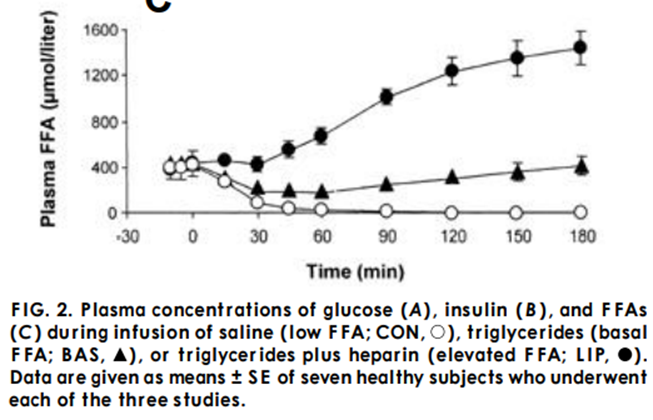
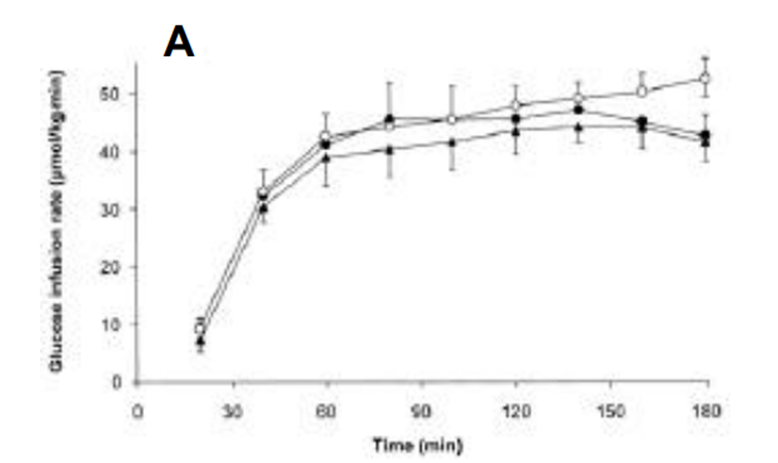
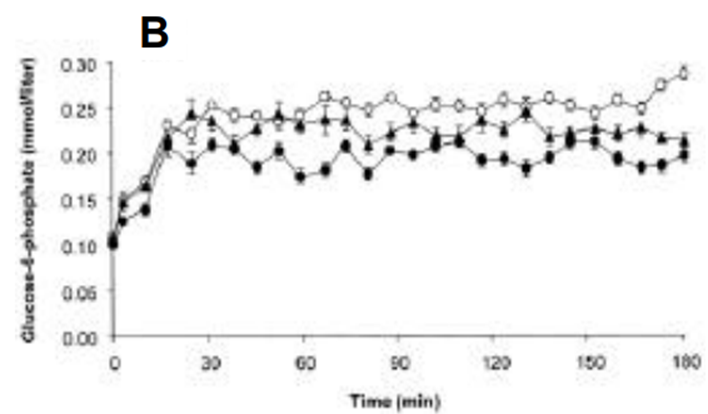
The two most important measurements in the study were the total blood glucose uptake (A) and the concentrations of glucose-6-phosphate (G-6-P) (B). G-6-P is a glucose molecule that is formed from glucose by the enzyme hexokinase. When glucose enters the cell, it is either broken down into energy, or converted into glycogen, the storage form of glucose. For both processes glucose is first converted to G-6-P.
The researchers' theory at the time was that a higher fat concentration in the blood leads to reduced glucose burning. This would result in a build-up of G-6-P in the cell, which then makes glucose uptake from the blood decrease.
“From in vitro studies (laboratorium studies), Randle et al. postulated that increased FFA oxidation inactivates pyruvate dehydrogenase with subsequent inhibition of phosphofructokinase. This would cause intracellular glucose-6-phosphate (G-6-P) to rise and then decrease hexokinase II activity with consequent decreased glucose uptake and glycogen synthesis.”
Glucose uptake
G-6-P
The study shows that there was no difference in glucose uptake between the three situations up to two hours after the fat was given. After 120 minutes, glucose uptake in the "very little fat" group (BAS) kept rising, while in the other two situations (in which fat was given in the blood) glucose uptake began to fall.
Remarkably, the concentrations of G-6-P were highest in the CON group (in which no fat at all was given). This suggests that the original theory about why fat in the blood has an effect on glucose uptake is not correct.
In the study by Santomauro et al., 43 participants were given both a placebo (a pill without an active effect) and a medicine that lowers fats in the blood. The participants were divided over four groups:
- People with obesity but without diabetes (or insulin resistance).
- People with obesity and limited insulin resistance (pre-diabetes).
- People with obesity and type 2 diabetes.
- A control group without obesity or glucose intolerance.
All participants had to eat 200 grams of carbohydrates per day for three days before the experiment. On day 1 they were given a placebo at 19.00, 01.00 and 07.00. On day 2 they were given the medication at the same times, after which they were connected to a drip. This allowed the researchers to measure glucose, insulin and fats in the blood.
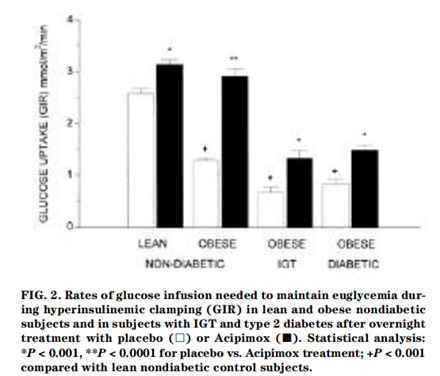
The higher the bar, the greater the glucose uptake in the body, from the blood into the cells. In all groups the medication (the black bars) led to better glucose uptake compared with the placebo (the white bars), with the largest effect seen in the group with obesity without insulin resistance.
In addition, all groups had improvements in glucose and insulin peaks after the intake of 75 grams of glucose, after they had received the fat-lowering medication for a night.
According to the authors, a chronic lowering of fats in the blood leads to less insulin resistance, because fats limit the action of insulin and counteract the formation of glycogen (glucose storage).
“FFAs cause insulin resistance through inhibition of insulin-stimulated glucose transport and/or phosphorylation, as well as by inhibition of glycogen synthesis, processes that require 3–6 h to develop. FFA-induced inhibition of carbohydrate oxidation, on the other hand, develops almost instantaneously but does not interfere with ISGU for several hours.”
Is eating fat a problem?
These studies both show that a chronic increase or decrease of fats in the blood can cause more or less insulin resistance. The authors of the previous study conclude the same.
“Lowering of overnight plasma FFA levels with Acipimox markedly improved insulin resistance, oral glucose tolerance, and basal insulin levels in obese subjects, regardless of the degree of their preexisting insulin resistance. These findings add to a growing body of evidence showing that elevated plasma FFA levels are an important link between obesity and insulin resistance.”
And here is the crux! The reduced uptake of glucose due to a chronic increase of fats in the blood is mainly a problem in people with obesity. As you can see in the study by Santomauro (the white bars in the figure above), the group without obesity had a glucose uptake twice as high as the group with obesity while on the placebo (both without insulin resistance).
There was therefore only a small effect of the fat-lowering medication on glucose uptake in people without obesity and without insulin resistance. Although the increase was significant (there is a high chance that the difference is not down to chance), the question arises whether it is also clinically relevant (does it have a noticeable effect on health)?
In contrast, the group with obesity but without insulin resistance had a strikingly large improvement in glucose uptake. This underlines how big the effect of obesity is on fats in the blood and thereby on glucose uptake.
Small side note: The fact that people can have obesity without insulin resistance also shows that diabetes is a complex health problem.
Finally, these studies did not test what the effect of eating fat is on insulin resistance, but rather what a chronic lowering or raising of fats in the blood does. The authors therefore state that a chronic increase of fats in the blood is a feature of obesity.
"Here, we have tested the hypothesis that FFAs are the link between obesity and insulin resistance/hyperinsulinemia and that, therefore, lowering of chronically elevated plasma FFA levels would improve insulin resistance/hyperinsulinemia and glucose tolerance in obese nondiabetic and diabetic subjects."
Eating fat does not necessarily cause such a chronic increase of fat in the blood. Nor can you stop eating fat in order to chronically lower your fats in the blood. We need fats to be healthy. Janneke acknowledges this in her book too.
Claim: eating fat limits glucose absorption (uptake)
Still, that is the argument Janneke wants to make.
"It is important to realise that this fat did not have to be given through a drip, but that researchers only had to give the test subjects some fat to eat. Eat some eggs, olive oil, butter or cream and within an hour and a half the absorption of glucose by your cells is impaired.” (translated from Dutch)
Source: Sweeney, JS. Dietary factors that influence the dextrose tolerance test. (1927)
For this she cites the study by Sweeney. Sweeney was one of the first to have the opportunity to test, with the help of scientific research, the theory that the composition of your diet influences how well your body deals with carbohydrates.
In this study 21 young medical students (men) were put on four different diets:
- Protein: meat and the protein of eggs.
- Fat: olive oil, butter, mayonnaise and cream.
- Carbohydrates: sugar, sweets, pastry, white bread, potatoes and oatmeal.
- Fasting: no food (nothing).
The participants followed these diets for two days. On the third day they were given 1.75 grams of dextrose (carbohydrates) per kilogram of body weight. Their blood glucose was then measured.
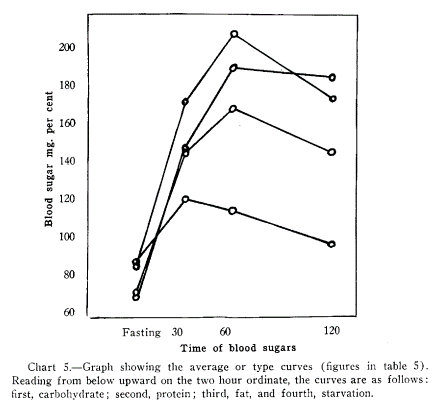
According to the authors, the carbohydrate group was the only group (bottom line) with a relatively normal blood glucose response. In all other groups there was an enormous peak in blood glucose, which had not normalised after two hours.
According to Janneke, this study proves that fat (and possibly also protein) affects glucose uptake. The authors of the study are less firm about this, however. They state that a balanced diet with fat, carbohydrates and protein probably leads to a healthy blood glucose response.
They attribute the extreme blood glucose response after a high-fat diet or fasting to a delayed insulin production. This effect would be less visible with high-protein diets, because proteins can be converted into carbohydrates in the body.
“In the next group of patients, namely, those receiving fats, the curves fall just where one would expect them to according to the theory proposed. As a result of much ingestion of fat, the activation of the insulin stimulating hormone has been reduced. This would cause a sluggish response when dextrose is ingested ; therefore, a rather steep rise in the blood sugar occurs until the insulin stimulating process has been completed… In health and as a result of daily eating of the usual mixed diet, this mechanism is working smoothly and flexibly; in other words, the response to carbohydrate ingestion is normal...”
If you ask me, this study only shows that when someone's diet consists solely of fats, proteins or nothing, the body (of healthy young men) can react less quickly to carbohydrates. This says nothing about the influence of fats on glucose uptake within a diet in which all three macronutrients are present.
The question is: do you prove with this that fat (and possibly also proteins) disrupts glucose uptake, or that not eating carbohydrates is responsible for this? (I think the latter.)
Claim: Also in healthy people. The less fat in your diet, the better insulin works.
Still, according to Janneke there would be more evidence that the amount of fat in a diet has an effect on the action of insulin. She even cites the same source twice (although she gives the source two different numbers) and states that fat not only inhibits the action of insulin, but also that a high-fat and high-protein diet has harmful effects on our blood vessels because of the influence on our blood sugar level and insulin levels
“Countless people try (in vain) to keep their blood sugar levels and insulin levels stable by using animal products and leaving out fruit, without there being scientific evidence for these theories. Whereas there is in fact a lot of research that points in the direction of the harmful effects of products high in fat and protein on our blood vessels, kidneys, liver, intestines and heart.” (translated from Dutch)
The first thing I notice about this study is the test subjects: rabbits. That happens more often in research, but in the book it seems as if evidence is cited that shows specifically what the effect is in humans. It is therefore not clear to me whether the statement “Also in healthy people” actually still belonged to the previously mentioned sources (which were indeed carried out in healthy young men) or to this study. Possibly I am interpreting this wrongly.
In any case, the rabbits got either a high-carbohydrate diet or a high-fat diet. While the rabbits were connected to a drip, they were repeatedly given insulin injections to investigate what the effect of these injections was on their blood glucose level.
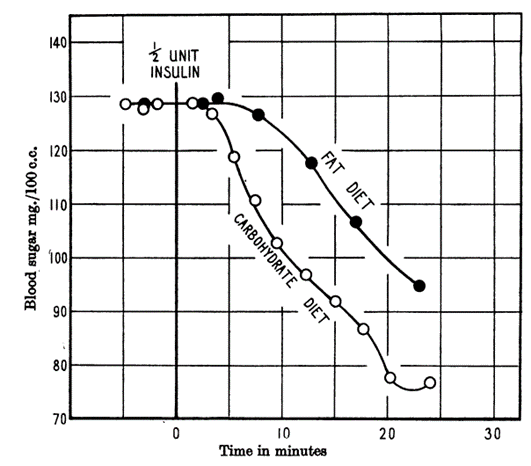
Among other things, this showed that blood glucose in the rabbits on a high-fat diet fell less quickly when an insulin injection was given. From the results you can conclude that in rabbits a high-fat diet does not inhibit the production of insulin but does inhibit the action of insulin, so that blood glucose stays in the blood for longer.
“The fat diet decreases sugar tolerance; retards and diminishes the action of insulin upon the blood sugar; prevents or delays the progressive improvement of sugar tolerance which occurs on injection of consecutive doses of glucose; and impairs the ability of insulin to diminish the hyperglycaemia following intravenous injection of glucose.. Our final conclusion, that the varying ability of an animal to deal with carbohydrate characteristic of each of these conditions is not due to a variation in response of the insulin secreting mechanism, but is due to a change in the animal's susceptibility to insulin.”
You cannot tell from this study how this translates to humans.
My conclusion
Based on these studies I conclude that a chronic increase of fats in the blood (which is often the result of overweight) can cause your body to deal less well with glucose. You could, however, also attribute this to an energy surplus in the body. After all, what is the body supposed to do with all those fats and glucose when there is already too much energy present?
This makes me think strongly of the Randle cycle, which I will come back to later. Maybe it is a natural and healthy reaction of the body to no longer let glucose into the cells when enough fats are already present. This suggests that insulin resistance can be a protective process to protect cells against an excess of energy.
Still, it seems that in rabbits a high-fat diet really does inhibit the action of insulin. In addition, it is very clear that the body responds less well to carbohydrates after a period in which no carbohydrates were eaten.
Janneke's conclusion
Based on these studies Janneke concludes that the advice to eat a high-fat and high-protein diet to prevent a (too) high insulin response and insulin resistance is unjustified and harmful. According to her, constantly fatty food makes sure that sugar cannot be taken up into the cells and keeps circulating in the blood, certainly with a sedentary lifestyle.
What I do notice, however, is that Janneke mainly talks about the effect of fats, while I thought there was also a protein problem. I will come back to this later.
First she goes on to the question: is sugar-rich food really the cause of higher blood glucose levels and insulin responses?
Claim: It is not the amount of carbohydrates or sugars that determines the size of the insulin response. Remarkably, steak, white fish or eggs caused an insulin response at least twice as large as, for example, 279 grams of banana, 435 grams of apple or 625 grams of orange.
For this claim Janneke refers to a study in which 38 foods (divided over six categories: fruit, bakery products, carbohydrate-rich products, protein-rich products and breakfast cereals) were tested in portions of 240 kcal on 11 to 13 healthy participants. The participants were fed these portions, after which finger pricks were taken to measure the insulin and glucose responses.
All scores were compared with the glucose and insulin response to white bread, which was used as the reference. A score of 90% means that the glucose or insulin response was 10% lower than with white bread, while a score of 110% indicates that the response was 10% higher than with white bread.
The results Janneke refers to are in the following figure:
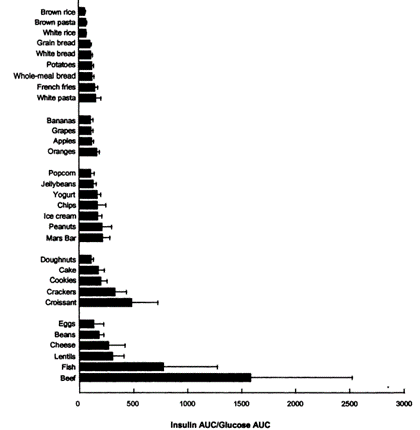
Here we see that products such as steak and white fish indeed cause a bigger response. There is an important caveat, however: this concerns the ratio between the insulin response and the glucose response.
The reason steak and fish score so high is that they cause a much lower blood glucose response compared with carbohydrate-rich products, while they do elicit an insulin response. If you look at the absolute value (with white bread as the reference), you get the following:
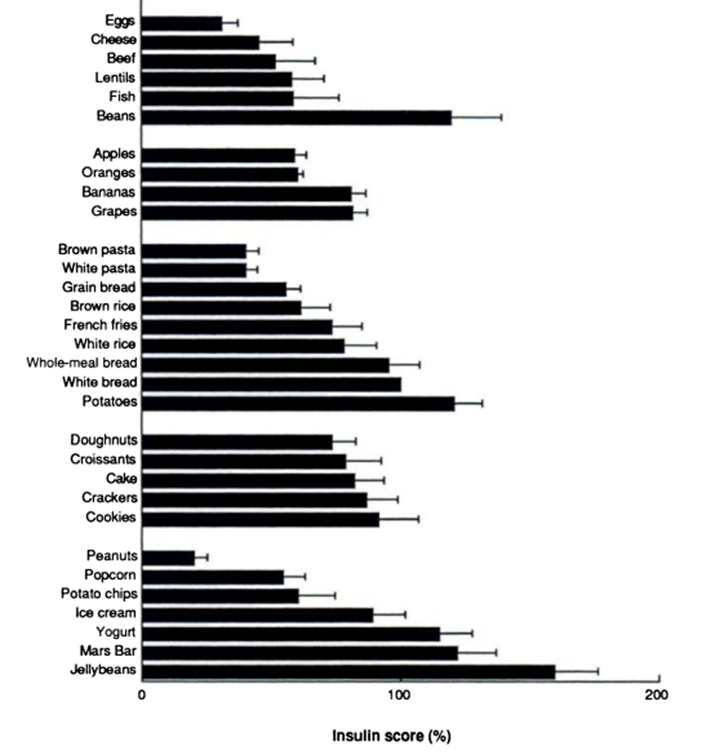
Equally remarkable results, if you ask me. For example that beans cause a higher insulin response than white bread, or that wholemeal bread causes almost the same insulin response as white bread. In addition, the authors point out that there was considerable variation between individuals, especially in the insulin response.
So Janneke makes a good point here: the insulin response is not determined solely by the amount of carbohydrates. According to the authors, an analysis shows that only 23% of the variation in insulin response can be explained by the carbohydrate content of a product. The remaining variation is partly explained by factors such as the amount of protein, fat, water, sugar and starch, which together explain only 33% of the insulin response in total.
Fascinating, right? Do you find this interesting? Then read my piece on the book by Spector and the PREDICT study, where I go into this in more depth.
“MultipIe-regression analysis of the individual results showed that the glycemic response was a significant predictor of the insulin response, but it accounted for only 23% of the variability in insulinemia. The macronutrients (protein or fat, water, sugar, and starch) were also significant predictors, but together accounted for only another 10% of the variability of the insulin responses. Thus, we can explain only 33% of the variation of the insulin responses to the 38 foods under examination.”
Janneke reasons that animal products are often rich in fats and proteins, and that these disrupt the functioning of organs and the communication of insulin. This does not mean, however, that it is wise to start eating refined sugars in unnatural products (because yes, according to her figure a Mars bar also has a lower insulin response than meat and fish). Still, she sees no reason at all to drop fruit and to eat animal products instead.
Proteins and blood glucose
Even though Janneke claims very firmly that proteins also play a role in disrupting the communication with insulin, so far she has actually only focused on fats. I find that strange, firstly because the book is called De Eiwitleugen, and secondly because quite a lot of research has been done on the effect of proteins on blood glucose and insulin.
In fact, it is even claimed that proteins are important for people with type 2 diabetes to regulate their blood glucose. This claim is based on experimental research. For instance, several intervention studies have shown that supplementation of milk proteins leads to a lower blood glucose peak after a meal. This effect is possibly explained by the influence of individual amino acids on glucose-dependent insulinotropic polypeptide (GIP).
Although there is still a lot of uncertainty, proteins seem to have an effect that is the opposite of what Janneke claims. I advise you to go through the studies; they are super interesting! There are too many to include in this blog, however. I found about 10 intervention studies; here are three examples:
Conclusion
Okay, let me summarise. In this chapter Janneke uses the Pyramid of Evidence Strength very nicely. Janneke tries to support her theory with mechanistic research in both humans and animals. In doing so she makes clear how she thinks fats have an effect on insulin resistance (and thus on glucose uptake in cells): the more fat there is in our blood, the less glucose is taken up in cells.
There are caveats, however. Eating fat does not necessarily cause a chronic increase of fats in the blood. Also, lowering fats in the blood in healthy, lean people seems to have little effect on glucose uptake in the body.
In addition, she wanted to show that eating fat inhibits the uptake of glucose in humans. The study by Sweeney, however, shows that this was not so much due to the fats in the diet, but rather to the absence of carbohydrates. If you never eat carbohydrates, the body will respond worse to carbohydrates when you do eat them once. Although this seems to be different in rabbits, you cannot translate these results one-to-one to humans.
Next she tries to show that carbohydrates are not the main cause of high insulin responses. That is right: there is more going on. She also states that animal products cause a much higher insulin response. This turned out not to be true. Relatively speaking, compared with blood glucose, animal products do indeed cause a higher insulin response. But if you look at absolute values, carbohydrate-rich products still cause a higher insulin response. Which is also logical.
Still, it is fascinating that there is an enormous variation between people in how they respond to food. I discuss this further in my piece on the book ‘Ingelepeld’ (Spoon-fed).
What I find striking is that proteins have so far not been clearly addressed by Janneke. This is remarkable, given that she states that diabetes is also the result of eating a lot of protein, and this book is called De Eiwitleugen.
Maybe this will be fully worked out in part 2 of this analysis, where Janneke continues to build her case by going into the effect of saturated fat on insulin resistance. In addition, she discusses intervention studies that show what the effect of a vegan diet on diabetes is.
Brainwave: The Randle cycle
Then I want to come back to the Randle cycle. I found out later that the first studies mention Randle and his hypothesis as the reason for measuring G-6-P.
“From in vitro studies (laboratorium studies), Randle et al. postulated that increased FFA oxidation inactivates pyruvate dehydrogenase with subsequent inhibition of phosphofructokinase. This would cause intracellular glucose-6-phosphate (G-6-P) to rise and then decrease hexokinase II activity with consequent decreased glucose uptake and glycogen synthesis.”
I only recently found out about the concept of the Randle cycle when I dove into the video by Bart Kay and Ryan Attar. (you can read more about this in my highlight about fats on instagram)
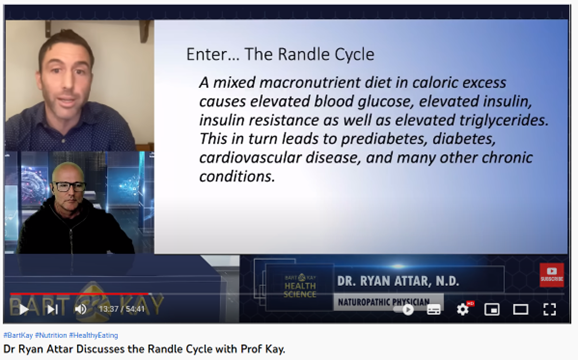
They claim that the Randle cycle is the reason why we should not eat both fats and carbohydrates (preferably only fats). The Randle cycle is a theory which states that carbohydrates and fats compete to be used as the energy source. When you eat both, the body might not be able to deal well with these two energy sources, which can lead to insulin resistance.
What I noticed in these men's video, however, is their definition of this cycle, and especially three words: ‘in caloric excess’. They say nothing about this themselves and suggest that eating both fats and carbohydrates is always a problem. But their own definition perhaps makes the most important caveat of all: this problem only arises when you take in too much energy.
And yes, that is also the feeling I have so far about Janneke's argument. Maybe there is only a problem with carbohydrates, fats and proteins when people take in too much energy. We will see in part 2.
What did you think? Let me know in the form of a comment or an email: [email protected]
Have you come across a claim on the internet or social media and are you curious about an assessment of its support, let me know and I will dive in!
Do you want to support me and my nutrition science adventure? Share my articles or the podcast on your socials!
Everything you read on this website is my opinion based on knowledge and experience. There is a good chance that I sometimes overlook something, or that something could be better. I would love to hear it!
We do science together.
Follow me or connect with me on:
Instagram: https://www.instagram.com/coenfirmation_bias/
Linkedin: https://www.linkedin.com/in/coen-dros/