
22 min read
Upfront on nutrition, also on science? (Upfront responds)
Upfront presented the Upfront pre. A pre-workout without unnecessary ingredients and with scientifically supported active ingredients in doses that should lead to improved sports performance without unpleasant side effects. Upfront is a young Dutch company with the mission to counter deception in the food industry through transparency. So they are transparent about the scientific support for their new product. But how strong is the scientific evidence? What do those improved sports performances actually mean? Does Upfront tell the same story as the science on which they base their claims?

The ingredient list of the product is short and is printed on the front of the packaging: strawberry powder and sweetener for the taste, an anti-caking agent and the active ingredients for better sports performance. This is typical of Upfront products and deserves praise. If only every producer were this transparent. But for the first time Upfront is on thin ice, because after focusing mainly on foods such as protein powder, protein bars and drinks, they are now coming to market with supplements that carry health claims. Scientifically supported health claims, according to Upfront -- yes, that is certainly thin ice. There is legislation that restricts making health claims, but on top of that, interpreting scientific literature is almost never simple. I dug into the support for the active ingredients and still found some important nuances that are not mentioned.
The active ingredients per two scoops (13gr) of the pre-workout are as follows:
3000 mg L-citrulline dl malate 2:1
3000 mg L-arginine alpha ketoglutarate
1900 mg Beta-alanine
1000 mg taurine
230 mg caffeine
For each ingredient I dug into the background, the literature and the claim, and where needed I give suggestions so that the claim is more accurate.
My own bias
I have Upfront products at home and I am a fan of both their products and their concept. So I bought the pre-workout too and I had a great time training on it (although the tingling comes very quickly and you do have to take it 60 min beforehand). Upfront is transparent and makes tasty products with as few ingredients as possible. They share a lot about their company and intentions, which takes consumers along in their story. Very strong if you ask me, I hope more companies will do this.
Citrulline, arginine and strength training
The first two ingredients, L-citrulline dl-malate 2:1 and L-arginine alpha ketoglutarate, are both amino acids. Citrulline is a non-essential amino acid that occurs in relatively high amounts in watermelon (0.7 to 3.6 mg per gram in (the rind of) watermelon). Arginine is a semi-essential amino acid, which means that we can make it ourselves but not enough. It is found mainly in animal products but also in nuts, soy and seeds. Citrulline and arginine work together in the body through a complex mechanism in which citrulline can be converted into arginine and the other way around, but the aim of supplementing citrulline and arginine is to raise the amount of arginine in the blood. This has a promoting effect on nitric oxide production in the body, which in turn should lead to better sports performance.
The mechanism goes as follows: higher levels of L-arginine cause more nitric oxide. An important action of nitric oxide is widening the blood vessels, which can allow your body to transport more substances. If you can transport more substances such as oxygen and fuel, muscles can function better and muscle fatigue sets in less quickly during high-intensity training. But for the same reason it is also sometimes sold as a miracle cure for erectile disorders. Citrulline is often supplemented together with malic acid because malate further increases ATP production. So the mechanism is clear, but what does research in humans show about these performance-enhancing substances? Since a plausible mechanism is not enough to make a claim about health effects in humans, it has to be tested in humans to be able to say anything about humans.
Varvik et al. carried out a systematic review and meta-analysis to investigate whether supplementing citrulline before strength training can increase the total number of repetitions of lower- and upper-body exercises to muscle failure in healthy adults.
In short, Varvik et al. found the following:
In total eight randomised controlled trials containing fourteen exercises, made up of exercises that work single muscle groups (for example bicep curls) or multiple muscle groups (for example leg press), with an average of 51 repetitions and 5 sets at an average of 70% of maximal strength per repetition. So if you can do 100 kilos for 1 repetition, the exercise is done with 70kg. Supplementing 6 to 8 grams 40 to 60 minutes before the exercise increased the number of repetitions significantly (p=.022) by 3 repetitions (6.4%) compared with the placebo group. With an effect size of Hedges’g = 0.196 (95% CI [0.029, 0.364]. When separate analyses were done for lower- and upper-body exercises, the results were weaker. The number of repetitions for the lower body increased by 8% with borderline non-significance (p=.051) and the number of repetitions for the upper body by 6%, not significant (p=.131), compared with the placebo group.
The authors conclude that supplementing citrulline before a strength training session can lead to a small increase in repetitions. Even though the effect size is small, supplementing citrulline could lead to an important increase in training volume and thereby improve sports performance.
If we then zoom in on Upfront's claim: ‘Supplementing with 6-8 grams of L-citrulline dl-malate taken 40-60 min before a training session leads to 3-5 extra repetitions compared with placebo.’
This corresponds reasonably well with what the researchers conclude, but there are things that stand out to me when we dig deeper into the results of the study. Firstly, the interpretation of the number of repetitions is not correct. Upfront claims that it can lead to 3 to 5 extra repetitions, but this is not quite true.
“The main meta-analysis resulted in an increase of 3 ± 5 weighted repetitions in the Citrulline Malaat condition compared with the placebo condition.” aldus Varvik et al.
Upfront interprets this as 3 to 5, but what it actually says is 3 repetitions with a standard deviation of 5. The standard deviation says something about the spread around the mean of 3.
Secondly, only one study (of the eight) uses 6 grams and only one study (of the eight) administers citrulline 40 minutes before the training. Neither study showed a significant effect of citrulline on the number of repetitions, and the 40 min study even showed a non-significant negative effect hedges’g -.072 (-.0320 - .324). So it does not seem correct to me to claim that 6 grams or 40 minutes would suffice for the positive effect of citrulline.
Finally, the positive effect was found mainly in the groups with exercises that worked multiple muscle groups such as bench press and that did lower-body exercises such as a leg press. It was mostly the studies by Chappell, in which exercises with single muscle groups (single leg extensions and bicep curls) were performed, that weakened the effect of citrulline heavily in the meta-analysis, as turned out from the sensitivity analysis. An explanation can be that the larger the muscle group is or the more muscle groups are worked, the more benefit can be gained from the vasodilation, according to Valvik et al. The studies by Chappell were, however, the only studies that explained the randomisation procedure and in which both men and women were included. That these studies show a (non-significant) negative effect is not mentioned by the authors, while it is interesting. Without these studies in the meta-analysis the positive results become considerably more significant.
Citrulline and Arginine together
But according to Upfront it is not feasible, because of clumping, to add more than 3 grams of citrulline to the product. Since the aim is to raise the arginine blood level, Upfront comes up with the solution of topping it up with 3 grams of arginine. Normally supplementing arginine is less efficient because it is broken down more quickly in the gut and liver. But when citrulline and arginine are supplemented together, this leads to even higher arginine blood levels than the substances on their own, according to Upfront. They base this on a study by Suzuki et al. with 45 healthy men who were given 2 grams of citrulline, 2 grams of arginine or a combination of 1 gram of citrulline and 1 gram of arginine for a week. On day 8 arginine blood levels were measured.
The result was the following:
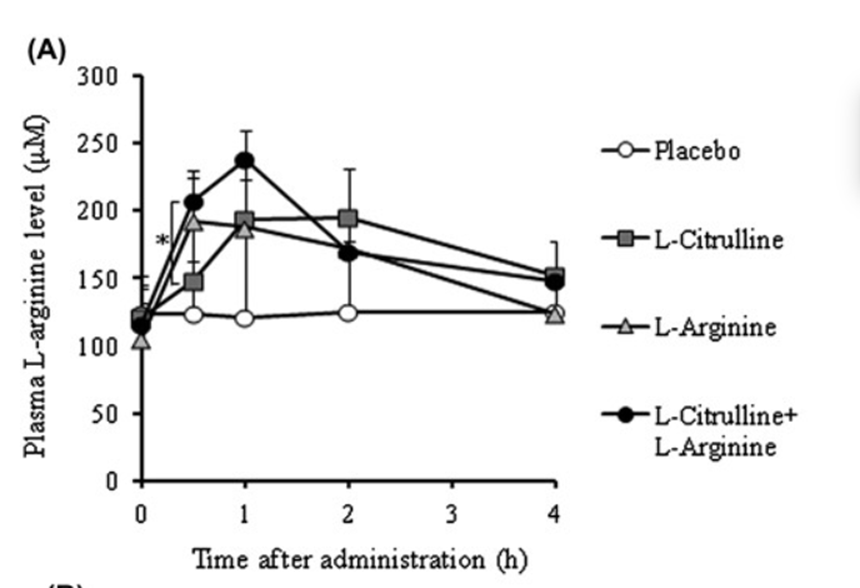
After half an hour the combination gave a significantly higher arginine blood level compared with citrulline, but not compared with arginine. After an hour it seems that the combination leads to a higher arginine blood level compared with citrulline and arginine supplementation, only this effect was not significant (p=.066). However, it turns out that baseline arginine blood levels can differ a lot between individuals, so the researchers exclude everyone with a value higher than 137 uM and do a second analysis. The result is as follows:
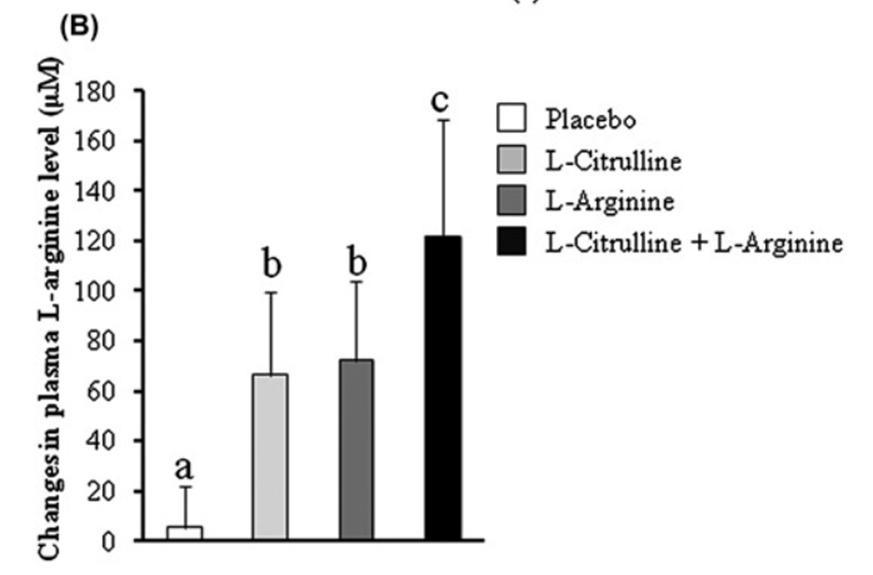
This shows that the differences then become larger and that the combination gives a significant increase in arginine blood levels compared with placebo and citrulline. The difference is not tested against arginine supplementation. According to the authors this difference is due to the limiting effect of citrulline on arginase, the enzyme that breaks down arginine, so that arginine is absorbed better when it is supplemented together with citrulline.
Nutrition science 101: The importance of baseline blood levels
An extremely important factor in nutrition science comes up here: baseline blood levels. Where food often differs from medication (although the epidemiology is often the same) is that nutrients are always present in the body. This is because everything we eat and drink contains small or large amounts of nutrients. So we always have a baseline level in our body. An important implication of this is that as a researcher you never compare a group without the substance with a group with the substance in the body. You compare a group that has some of the substance in the body with a group that has more of the same substance in the body. This means that a person's baseline levels have a large influence on the result. So it turns out that the amount of arginine someone has in the blood has an effect on the rise in arginine with supplementation. This literally means that two individuals who both take the same supplement can experience different effects because their baseline blood levels were different. On top of that, it can be that someone with a lower blood level benefits more from a supplement than someone with a higher blood level, because the greatest benefit may be in a rise from 50 to 100 and not from 100 to 150. This applies to all vitamins, minerals and nutrients we do research on. Researchers or people who interpret research have to take this into account. If not, you actually do not know what you are investigating or which claims you can make on the basis of the results.
In short, it is not clear whether the significant rise in blood level is also clinically relevant (does a doubling of arginine levels even matter?), because it is not clear which blood level you should aim for to promote the number of repetitions you can do during strength training. The meta-analysis did not investigate that. It is also not clear how high the arginine blood level becomes from 8 grams of citrulline and whether 3 grams of citrulline and 3 grams of arginine (which is in the pre) is comparable. We also do not know how this works in women, since Suzuki et al. state that they excluded women because of the effect of the menstrual cycle on these blood levels. Many uncertainties, while Upfront's claim seemed very clear and simple.
So how strong is the evidence for the 3 grams of citrulline and 3 grams of arginine as active ingredient in the Upfront pre?
Let us first state that a systematic review and meta-analysis of randomised controlled trials (RCTs) is at the top of the Pyramid of Evidence Strength. Especially when we want to look at a medication-like acute effect, as with citrulline and arginine, RCTs are the gold standard. However, there are certainly limitations that we have to take into account, such as the baseline blood level of the people who take it, sex and type of exercises. The mechanism is clear, the higher the arginine blood level, the higher the nitric oxide production -- which could improve sports performance. But when we look at research in humans, a lot is still unclear. Yes, when you give men 8 grams of citrulline 60 minutes before a training session there could possibly be a performance-enhancing effect. At least, when it concerns exercises with multiple or larger muscle groups. The effect is small but every little bit can help. The effect is not 3 to 5 repetitions, but on average 3 repetitions with a considerable spread of 5 repetitions around the mean per standard deviation. Whether this effect is also achieved with 3 grams of citrulline and 3 grams of arginine has never been investigated and therefore cannot be claimed on the basis of this literature, but it cannot be refuted either.
A suggestion for the claim could be: ‘Supplementing with 8gr L-citrulline dl-malate taken 60 min before a training session could lead in men (with a not too high baseline arginine blood level?) to 3 (with a spread of 5) extra repetitions in exercises where larger or multiple muscle groups are used compared with placebo.’
Reaction from Upfront
“We will look at the statements we made again and adjust them where necessary. The results of the two studies were combined and translated into the current composition. Hopefully we will indeed one day be able to test this combination + other ingredients in a controlled setting.”
Taurine and cardio
With taurine I immediately think of energy drinks. Producers of energy drinks apparently do not put it in there for nothing.
Taurine is an amino acid that is found mainly in meat, crustaceans and shellfish. It has an important role in biological processes in muscle fibres, such as a promoting effect on our mitochondria (energy factories) and thereby on energy metabolism. The question then is whether taking a high dose of taurine leads to an acute promoting effect on exercise.
Waldron et al. carried out a systematic review and meta-analysis on taurine supplementation and cardio exercises such as running and cycling.
In short, Waldron et al. found the following:
In total ten studies (randomised controlled trials) that investigated the effect of taurine on time to exhaustion, power and distance in cardio exercises such as cycling and sprinting in adults with different health status. When all studies were pooled there was a significant small to moderate improvement (hedges’g = 0.40, 95% CI 0.12–0.67, P = 0.004) in endurance from supplementing 1 to 6 grams of taurine per day, both acutely (1 dose) and chronically (multiple doses over the day). With a borderline non-significant heterogeneity. When the meta-analysis was split by acute or chronic and by time to exhaustion, power or distance, there was no difference between acute and chronic and only a significant effect on time to exhaustion. There was also no extra effect, as Upfront also states, at a higher dose.
The authors conclude that supplementing 1 gram (1 dose) or 6 grams (spread over two weeks) can improve endurance, and thereby sports performance, a little.
If we then zoom in on Upfront's claim: ‘1 gram of taurine promotes endurance.’
This at least corresponds reasonably well with what the authors of the study conclude. It is important to realise, though, that it concerns cardio (running and cycling) and not strength training
When we dig deeper into the study, there are a few things that stand out to me. When we look at how large the effect was on time to exhaustion, we see big differences between studies. It ranges from a percentage increase of 2.6 to 17.5 or 25. And I think wow! 17.5 or 25 per cent longer to exhaustion, that is a lot. But then we see an important difference in these studies: the populations. These studies involve people over 60 with heart failure. The authors name this as limitations, but the positive effects would be spread over both healthy and unhealthy adults.
“Firstly, it is noted that our study selection incorporated findings from both healthy volunteers and heart failure patients, of varying ages. It is possible that the health or training status of the subjects would influence the effects of taurine; however, there were not sufficient data to investigate this hypothesis. As identified in Fig. 2, the largest effect sizes were shared between healthy and non-healthy subjects, inferring that this would not have affected the outcome of the analysis.”
And I do not entirely agree with that. The highest percentages are found in adults with heart failure, a group that is in very poor condition and therefore has the most to gain. One of these studies is also one of the few studies that show a significant effect. In addition, the significance of heterogeneity of this analysis is also borderline significant (p=.051). The authors do not see this as a problem, but I would still say that it raises the suggestion that there is certainly a difference between the studies they put into the same analysis, for which the difference in populations can be a good reason. Unfortunately this has not been checked with sub analyses.
So how strong is the evidence for 1 gram of taurine as active ingredient in the Upfront pre?
Here too it can be stated first that the design of the study, a systematic review and meta-analysis of RCTs, provides powerful evidence. There is certainly the suggestion that taurine can improve endurance, but the effect seems to be very small -- especially in healthy adults. Here too you could say: every little bit helps.
A suggestion for the claim could be: ‘1 gram of taurine, for cardio exercises such as cycling and sprinting, promotes the endurance of healthy adults a little and perhaps promotes it a lot for adults with heart failure.’
Reaction from Upfront
“Good that you took another closer look at the different studies that were used in the systematic review. You make an important point, but with Taurine we have not made any statements about the effect size of 1 g Taurine either.”
Beta-alanine and exercise capacity
Upfront added beta-alanine to the pre-workout because of its effect on carnosine levels in the blood. More carnosine should lead to less rapid acidification in the muscles, so that athletes keep exercising for longer and thereby deliver better performances.
Beta-alanine is an amino acid that is found mainly in skeletal muscle, which is why we get it when eating fish, meat and poultry. Beta-alanine is different from many other amino acids because it has other functions besides forming proteins. For example, beta-alanine can bind with histidine to form carnosine. Carnosine then limits the increase in the pH value in muscles, so that acidification occurs less quickly. Carnosine is broken down by enzymes, which makes it not useful to supplement, and beta-alanine could therefore be a perfect solution. The question then is whether we also see this in studies with humans.
Upfront cites a narrative review. To also assess the strongest evidence for this active ingredient, I focus on the systematic review and meta-analysis that is cited in the review.
Saunders et al. carried out a systematic review and meta-analysis with which they investigated the effect of beta-alanine supplementation on exercise capacity and sports performance.
In short, Saunders et al. found the following:
In total 40 studies with more than 65 exercises (this ranges from swimming to cycling to strength training, really everything) with more than 1400 participants in total. Exercise capacity is defined as endurance (so how long until exhaustion) and sports performance is defined as how high or how far someone jumps/swims/runs etc. A substantial body of evidence compared with the other active ingredients. When all studies are pooled, beta-alanine has a significant small promoting effect on sports performance (both capacity and performance) (Morris = 0.18 95% CI: 0.08 – 0.28). This effect is significantly influenced by the duration of the exercises, but a split analysis also shows that the largest effect is on exercise capacity (0.4998 (95% CI 0.246 to 0.753). In addition, it turns out that especially co-supplementing with sodium bicarbonate leads to the largest effect. Furthermore, it made no difference what type of exercise protocol (continuous or intermittent) was followed, what the training status (untrained or trained) of the participants was or what the total amount of beta-alanine was that was taken.
The authors conclude that beta-alanine has a significant promoting effect on sports performance (both capacity and performance), but that there are many factors that influence this effect.
If we then zoom in on Upfront's claim (here I have merged several claims): ‘Daily supplementing 3-6 grams of beta-alanine for at least 4 weeks increased carnosine levels in the muscles. Higher carnosine levels > less rapid acidification > longer endurance > better performance. So it does nothing unless you take it daily, but it also gives a tingling sensation and tests plus surveys show that this is experienced as stimulating and that is why 1900mg has been added to the pre-workout.’
It stands out to me that the choice was made not to add 3 grams per day to the pre. So you do not reach the recommended dose for better sports performance if you stick to the dose recommended by Upfront. In addition, it turns out that supplementing with sodium bicarbonate leads to stronger effects, and it is not clear why Upfront did not choose this combination. In any case, the meta-analysis does confirm that supplementing beta-alanine can strengthen your endurance. Still, a few things stand out when you dig deeper into the meta-analysis. For example, there was no significant promoting effect of beta-alanine when people exercised for longer than 10 minutes. Which suggests that the positive effect on acidification is mainly in the first 10 minutes.
The authors do state that supplementing 1.6 grams per day for at least 2 weeks already leads to increased carnosine levels, but that effects on sports performance are only really seen at 3 to 6 grams per day for at least 4 to 12 weeks. This corresponds with what Upfront concludes, so what remains is the question of why there is only 1.9 grams in the pre. Especially because no sodium carbonate has been added, which according to the authors can be important for better effects. The authors advise athletes to supplement for at least 2 to 4 weeks 3.2 to 6.4 grams per day at different times of the day (0.8 to 1.6 grams every 3 to 4 hours) to prevent negative effects.
“Individuals are advised to supplement daily with β-alanine for a minimum of 2–4 weeks at a dose of 3.2–6.4 g/day ingested at several time points throughout the day (0.8–1.6 g every 3–4 hour) to avoid acute side effects”
So how strong is the evidence for 1.9 grams of beta-alanine as active ingredient in the Upfront pre?
Compared with the other active ingredients, there is a large body of evidence for the effect of beta-alanine on sports performance. There is a lot of difference in which types of sports have been investigated, but still there seems to be a positive effect on endurance, especially between 0.5 and 10 minutes. Certainly when you supplement higher doses for a longer period and preferably with sodium carbonate added. This confirms the mechanism in which beta-alanine raises carnosine and thereby counters acidification in the muscle. This effect is just not feasible with the pre, but Upfront already states this itself. So it is only in there for the tingling sensation, which according to Upfront is experienced as stimulating by people. It is a bit strange to still cite the literature, then, but it is at least transparent. The positive effect of beta-alanine is confirmed by the ISSN (international society of sports nutrition).
A suggestion for the claim could be: ‘Daily supplementing 3-6 grams of beta-alanine, especially together with sodium bicarbonate, for at least 2 to 4 weeks increased carnosine levels in the muscles. Higher carnosine levels > slightly less rapid acidification > slightly longer endurance in both strength and cardio exercises > slightly better performance. So it does nothing unless you take it daily and enough, but it also gives a tingling sensation and tests plus surveys show that this is experienced as stimulating and that is the reason why 1900mg has been added to the pre-workout.’
Reaction from Upfront
“Thanks to the continuous research on the performance-enhancing effect, the effect of Beta-alanine is slowly becoming beyond dispute. Unfortunately, with a pre-workout that is not consumed daily we cannot achieve this promoting effect. We then looked at which characteristics/ingredients/sensations of a pre-workout are important to a consumer. Of these, a light tingling (paraesthesia)(of course the intensity of this depends on the person) turned out to be an indispensable point. Beta-alanine in all likelihood gives this sensation above 1.6 g. After in-house testing and surveys, 1.9 g then turned out to be ideal for this sensation.
Furthermore, Sodium Bicarbonate is a nice ingredient to bring about delayed acidification. However, if you look at the study you refer to, it turns out that this involves 500 mg/kg body weight. Let us assume a person of 75 kg, then 37.5 g of Sodium bicarbonate is needed. Which is not realistic for use in a pre-workout. The ingredient came up in our search, but turned out to be impractical.”
This is correct. Several studies that looked at co-supplementing sodium bicarbonate used amounts of 0.3 to 0.5 grams per kg body weight. A nice example of how I sometimes do not look beyond the end of my nose either.
Caffeine and sports performance
I end with caffeine because this is probably the most researched active ingredient for improving sports performance. When I search for caffeine and sports performance in Pubmed you quickly find hundreds of articles, against dozens for the other active ingredients. There is therefore a gigantic body of evidence that I will not dig into any further.
The ISSN took an official position on caffeine last year. In short:
-
Caffeine supplementation has been shown, in many but not all studies, to have an acute positive effect on sports performance. These are small to moderate benefits for muscular endurance, movement speed and muscle strength, sprinting, jumping and throwing performance, as well as a wide range of aerobic and anaerobic sport-specific actions.
-
The most consistent moderate to large benefits are for aerobic endurance, but the size of the effect differs between individuals.
-
3 to 6 mg per kg body weight is the sweet spot. 2 mg is the minimum and 9mg causes unpleasant side effects.
-
60 minutes before exercise is usually best.
-
It works for both untrained and trained people.
-
People can have a genetic predisposition for sensitivity to caffeine. This determines how much effect it has on exercise but also how many adverse effects it has on sleep and/or feelings of anxiety. But tolerance (decrease in effect through daily use) is also an important factor.
-
It leads to better cognitive function: better focus.
-
It also works to promote endurance training in the heat or at altitude.
-
Alternative sources such as chewing gum etc. also work.
-
Energy drinks and other supplements with caffeine also work.
If we then look at Upfront's claim: ‘3mg per kg body weight leads to improved performance, but does not cause side effects.’
This is correct, and it is certainly on the safe side. This is also fairly important since you add caffeine based on the weight of an average person, but everyone has a different weight and therefore has to look for themselves at what the optimal amount is. So also keep in mind drinking other products with caffeine, such as coffee. For most people, unpleasant side effects can occur from 5 mg per kg body weight. In addition, it is important to keep in mind that genetic predisposition for sensitivity plays a very important role. So whether caffeine helps depends on your genes. Take this into account, be careful not to take too much.
Approval of health claims for foods
I still have something to say about claims and legislation. Food information must not be misleading, this is laid down in Dutch and European legislation. It concerns claims that say something about a food. The European Claims Regulation contains a broad definition of the term claim: “any message or representation which is not mandatory under European or national legislation, including pictorial, graphic or symbolic representation, in any form, which states, suggests or implies that a food has particular characteristics”. Claims can be words or text, but also in the form of pictures, symbols (e.g. a heart or a vein), a graph in which foods are compared. Claims can be used on a label, a website or in an advertisement, but also in a blog, a leaflet, direct mailing etc.
Upfront has been on thin ice since it started offering products such as omega-3, and so also the pre. None of the active ingredients mentioned above have permission for claims. Authorisation of claims can be applied for by producers, after which an expensive and long process is set in motion. This is therefore not feasible for 99% of producers.
In 2018 I wrote a piece for VoedingNu about Unilever and the approval they received from the European Food Safety Authority (EFSA). It was about black tea: “Because of its caffeine content, black tea promotes attention in people. After consumption, consumers can concentrate better and filter and use incoming sensory information better.” Because Unilever applied for this claim and supplied all the necessary evidence, they have the exclusive rights to this claim for 5 years. For this they had to set up three intervention studies in which participants had to drink the tea and carry out tasks. On the basis of the evidence supplied, the EFSA concludes that a direct link was found between the consumption of black tea and enhanced attention among adults. For this, two to three servings of black tea have to be drunk within 90 minutes. The two to three servings are equivalent to 75 mg of caffeine. For comparison: a cup of filter coffee contains 85 mg of caffeine and the pre-workout contains 230 mg.
Setting up three intervention studies is incredibly expensive and there is a big risk because if you do not get the results you need, it has all been for nothing. As I said, this is impossible for many producers. That a claim has no authorisation from the EFSA does not mean that it is not true, but it does determine whether you may make claims about it in advertising or on the packaging. Which is of course very warped, because it means that big powerful companies determine which claims you can make (after which they have exclusive rights to them) and this is also evident from the quote by Clive Gristwood, chair of R&D Food & Refreshment at Unilever: “We are pleased that we are one of the few companies that have achieved this and consider it a reward for our commitment to years of research into the benefits of the drinking of tea.”
Conclusion
The literature that Upfront cites to support their active ingredients has quite a few snags. The claims are therefore often a bit too much of a shortcut, but that is also the difficult thing about nutrition science: it is never simple. In any case, it does concern evidence with strong evidential weight, and the pre-workout contains the least speculative ingredients and safe doses. The evidence shows that there are probably small positive effects on sports performance in strength and endurance sports, although this can differ per person (because of baseline blood levels, health status, age and genes), per supplementation protocol (frequency and co-supplementation) and per sport and muscle group.
But let it be clear, the combination of active ingredients in the pre and its effect on sports performance has never been investigated. So it is not clear whether combining small effects leads to neutral, larger or perhaps even negative effects. It is certainly a nice hypothesis to investigate, who knows, Upfront may one day become so big that they can do this themselves. I hope so.
What did you think? Let me know in the form of a comment or at my email: [email protected]
Have you come across a claim on the internet or social media and are you curious about an assessment of its support, let me know and I will dive in!
Everything you read on this website is my opinion based on knowledge and experience. Chances are that I sometimes overlook something, or that something could be better. I would love to hear it! We do science together.
Terms
Randomised controlled trials (RCTs): Randomised controlled trials are experimental in nature. This means that the researchers divide the participants into groups: the intervention group and the placebo/control group. Participants in the intervention group receive the intervention, for example a supplement or diet, and the control group does nothing or receives a placebo. Back to where you were.
Significant: (Statistical) significance, also called the P(robability)-value, stands for the probability that the result found was found while the null hypothesis (there is no effect or difference) cannot be rejected. In other words, significance stands for the probability that the result found is based on chance and when this probability is small enough the null hypothesis can be rejected and the alternative hypothesis accepted. Back to where you were.
Effect size: Effect size: An effect size says something about how large the effect of an explanatory variable is on an outcome. Where significance says something about the probability of the result being due to chance, an effect size gives a handle for judging how important the effect is in the real world. There are different formulas that calculate effect size. A rule of thumb is that an effect size of 0.2 is a small effect, 0.5 is a medium effect and 0.8 is a large effect. Back to where you were.
Effect size Hedges'g: Hedges’g is a formula to calculate the effect size on the basis of the difference between the intervention and placebo group. It is often used in studies with small group sizes (<20). It uses the mean of the two groups and divides it by the pooled standard deviation so that the spread around the mean is taken into account. Back to where you were.
Sensitivity analysis: In meta-analyses the results of different studies are pooled to form an overarching result. Sometimes the influence of individual studies on the overarching result is checked by removing them from the analysis and then comparing the results. We call this a sensitivity analysis. Systematic reviews and meta-analyses are always the result of choices made by researchers, for example the search strategy, inclusion criteria and the assessment of the literature. These choices can have a large influence on the final result, but through a sensitivity analysis it can be checked whether individual studies, which have perhaps been included through doubtful choices but are included nonetheless, do not have too large an effect on the final result, or what this effect exactly is and how it can be explained. This makes the final result of the meta-analysis even stronger. Back to where you were.
Heterogeneity test: heterogeneity test tests whether there is a significant difference between the studies that are included in the meta-analysis. The aim of a meta-analysis is to pool the results of different studies. It is then of course important that the studies are at least somewhat similar so that you can use them for the meta-analysis. When we talk about differences you can think of having a different design (methodological diversity) or a difference in population and outcome (clinical diversity). This diversity causes a difference in the effects of the intervention that cannot be explained by chance but by substantial differences between the studies. You can test this and it is called statistical heterogeneity. Back to where you were.
Effect size Morris: Morris is a formula to calculate the effect size on the basis of the mean difference between before and after the intervention, divided by the standard deviation from before the intervention. The group size is also taken into account. Back to where you were.